Lebanon: More Posts, Less Engagement on X
Posts about Lebanon on X surged, but engagement per post fell sharply within 48 hours, dropping by over 95% as volume increased.

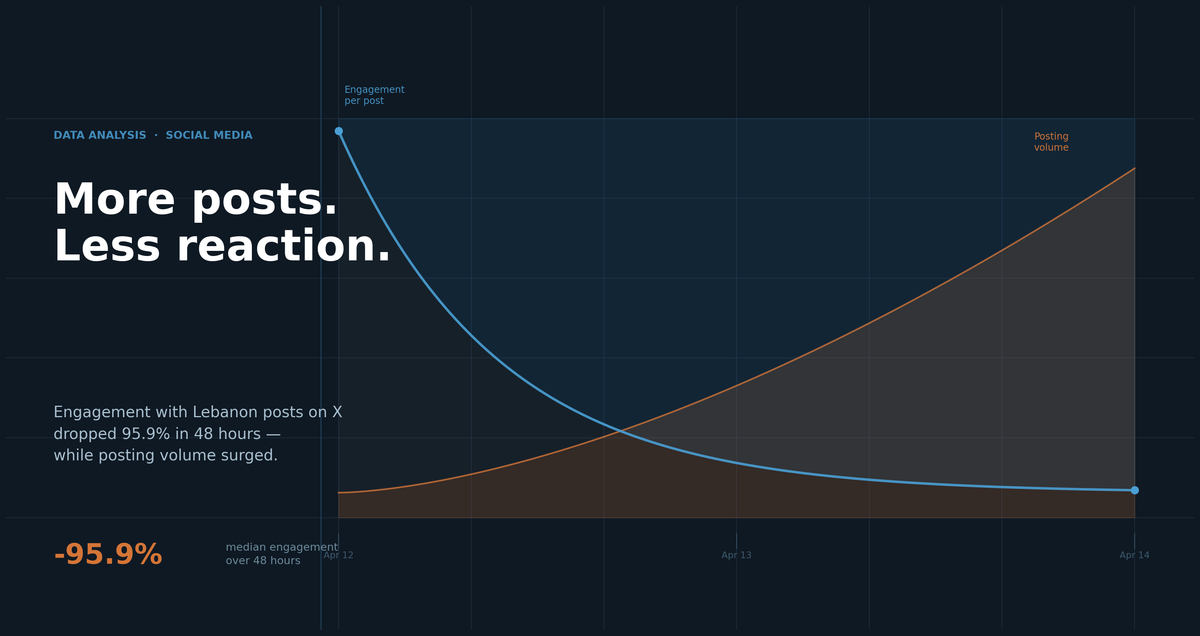
Engagement with posts about Lebanon on X collapsed within 48 hours — even as posting volume increased more than tenfold.
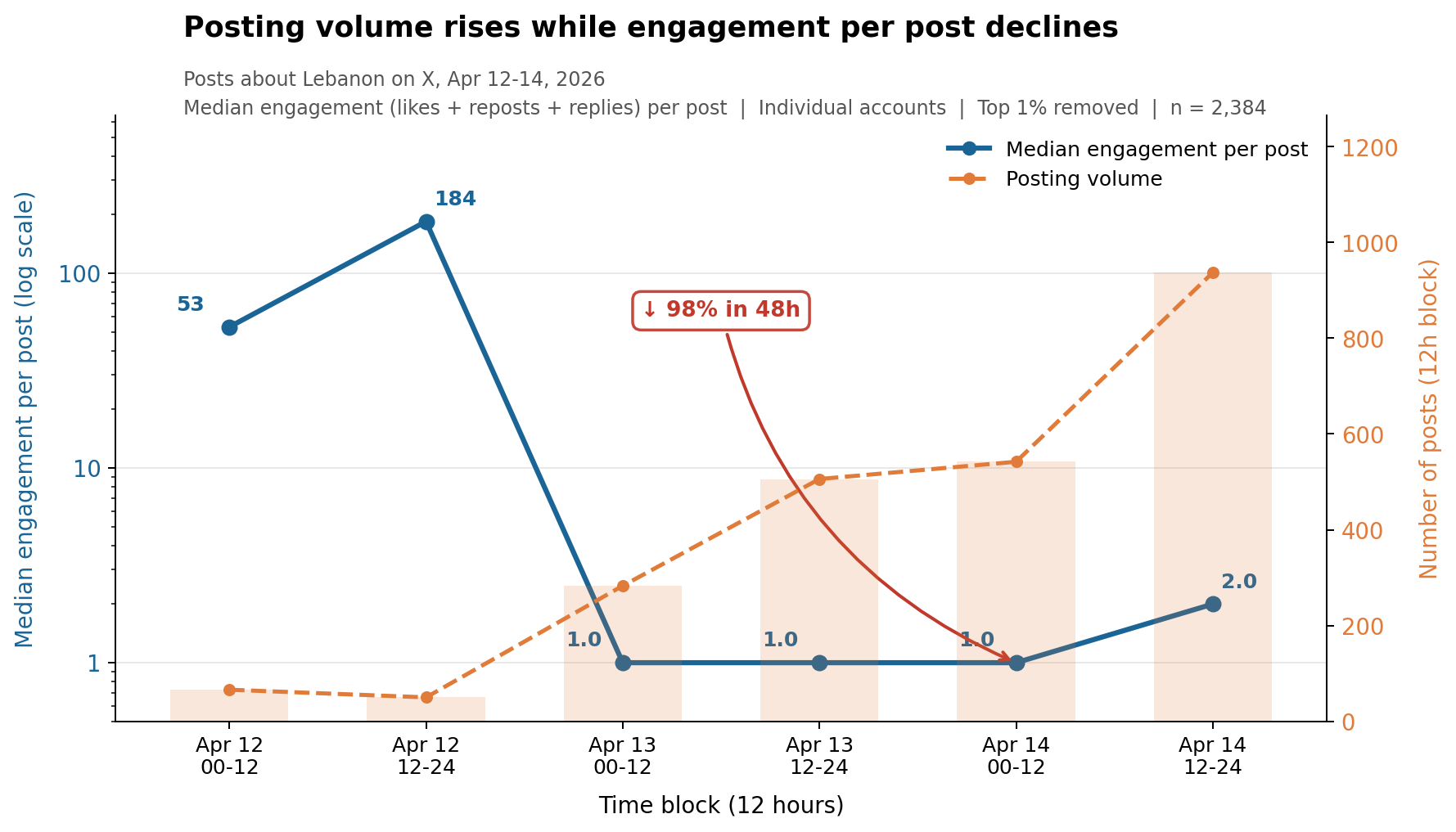
In a 72-hour dataset, median engagement per post fell by 95.9%, dropping from 48 interactions in the first 24 hours to just 2 in the last 24 hours.
More content was being shared, but each post received far less engagement.
This analysis focuses on posts about Lebanon tied to ongoing events, based on event-related keywords, rather than all content about Lebanon on X.
Main finding
From April 12 to April 14, 2026, engagement per post declined sharply while activity increased. The decline appears across all versions of the dataset — after removing high-frequency accounts, separating English and Arabic posts, and adjusting for exposure time.
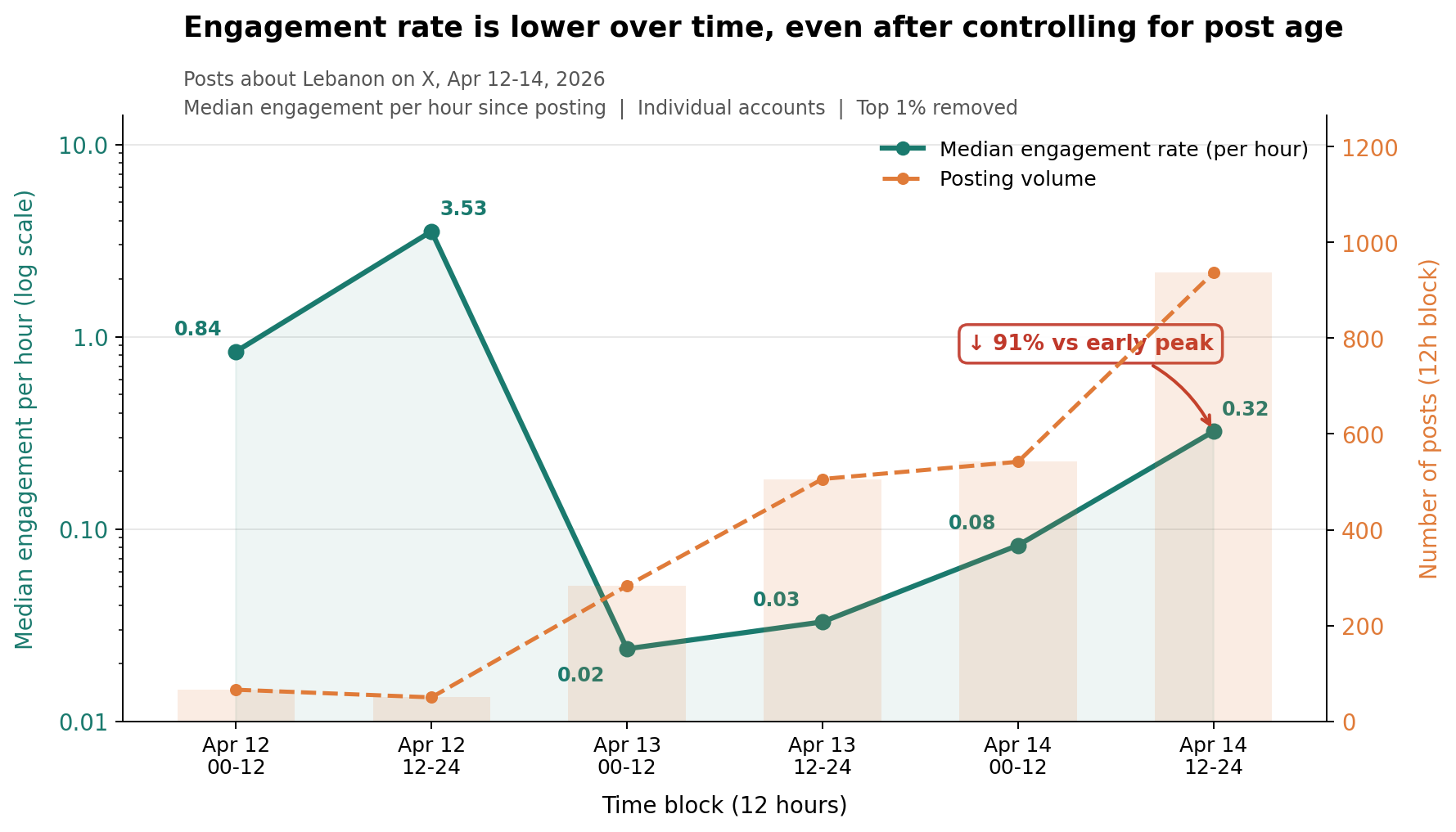
Using a time-adjusted metric, engagement per hour still declined by 71.2%. In the strictest version of the dataset — excluding wire accounts and outliers — the drop reached 98.7%.
What the data shows on X about Lebanon engagement
The table below summarizes results across four analytical conditions. “Early” refers to the first 24 hours of the window (April 12); “late” refers to the final 24 hours (April 14). All figures use median engagement per post on X.
| Condition | Median (early) | Median (late) | % change | Time-adjusted % change |
|---|---|---|---|---|
| All posts | 48.2 | 2.0 | -95.9% | -71.2% |
| No wire accounts | 118.8 | 1.5 | -98.7% | -90.8% |
| English only | 162.0 | 4.2 | -97.4% | -81.4% |
| Arabic only | 31.5 | 1.5 | -95.2% | -90.0% |
Three key findings
1. Engagement drops sharply over time across all audiences
Engagement per post declines by more than 95% in both English and Arabic datasets. After adjusting for time (engagement per hour), the drop remains between 70% and 90%.
2. The decline is not driven by high-frequency accounts
Removing high-volume accounts — including media and wire-style publishers — does not reduce the effect. The decline becomes steeper, indicating that the pattern is driven by typical users.
3. The pattern holds after controlling for timing bias
Earlier posts have more time to accumulate engagement. After adjusting for this using engagement per hour, later posts still receive significantly less engagement.
At the same time, posting activity moves in the opposite direction. The number of posts rises steadily across the 72-hour window, from 66 posts in the first 12-hour block to 937 in the final block. More content is being published, but each post is receiving less attention.
Why this drop in engagement matters on X
The drop happened quickly. Within one to two days, posts about the same events were getting far less engagement than earlier ones.
In simple terms: more content, but less reaction to each post.
This is not a drop in information — it is a drop in response.
One likely explanation is saturation. When many posts about the same events appear in a short time, each new post adds less new information. As a result, it feels less urgent and less worth reacting to.
Repetition also plays a role. When users see similar updates again and again, they don’t need to engage with each one to stay informed. They’ve already seen the story.
This pattern is often described as attention fatigue — a common effect in high-volume news cycles, where continuous updates reduce how much people respond to each individual post over time.
Methodology
Data collection
Posts were collected from X using keyword-based search queries. Two datasets were built: one in English and one in Arabic. All search terms were event-based, with no political actors included. Results were retrieved in chronological order (“Latest”) to avoid engagement bias.
Search terms
The English dataset was built from three keyword phrases: Lebanon strike, airstrike Lebanon, and explosion Lebanon. The Arabic dataset was built from six keyword phrases: جنوب لبنان, قصف لبنان, غارة لبنان, انفجار لبنان, دوي لبنان, and إطلاق نار لبنان. All terms were event-based, with no political actors included.
Dataset size
The English dataset contains 878 posts and the Arabic dataset 2,913. After merging and cleaning, the combined dataset contains 3,334 posts.
Cleaning
Retweets were removed. Posts were deduplicated and filtered for relevance. The dataset was restricted to April 12–14, 2026 (UTC).
Outliers
The top 1% of posts by engagement were removed to limit the effect of viral content. Results were consistent with and without this step.
High-frequency accounts
Accounts posting more than 20 times during the window were classified as high-frequency or publisher accounts. Removing them did not change the result.
Engagement metric
Engagement is defined as the sum of likes, reposts, and replies per post. Median engagement per post is used to reduce the impact of extreme values.
Time adjustment
To control for exposure time, engagement per hour was calculated for each post. Median rates were compared between early and late periods.
Final sample
After all cleaning steps, the final analytical sample includes 2,360 posts: 698 English and 1,662 Arabic.
Related Research
 Mohamed Soufan
 Mohamed Soufan
 Mohamed Soufan
Media & Contact
For media inquiries or interviews about this research, please use the contact page.