Media coverage during armed conflicts tends to focus on military developments. But people living through these periods often search for more immediate concerns, including economic conditions, daily life, and the possibility of leaving the country.
This study compares English-language media coverage of Lebanon with public information demand, using Google search behavior from March 2026.
💡
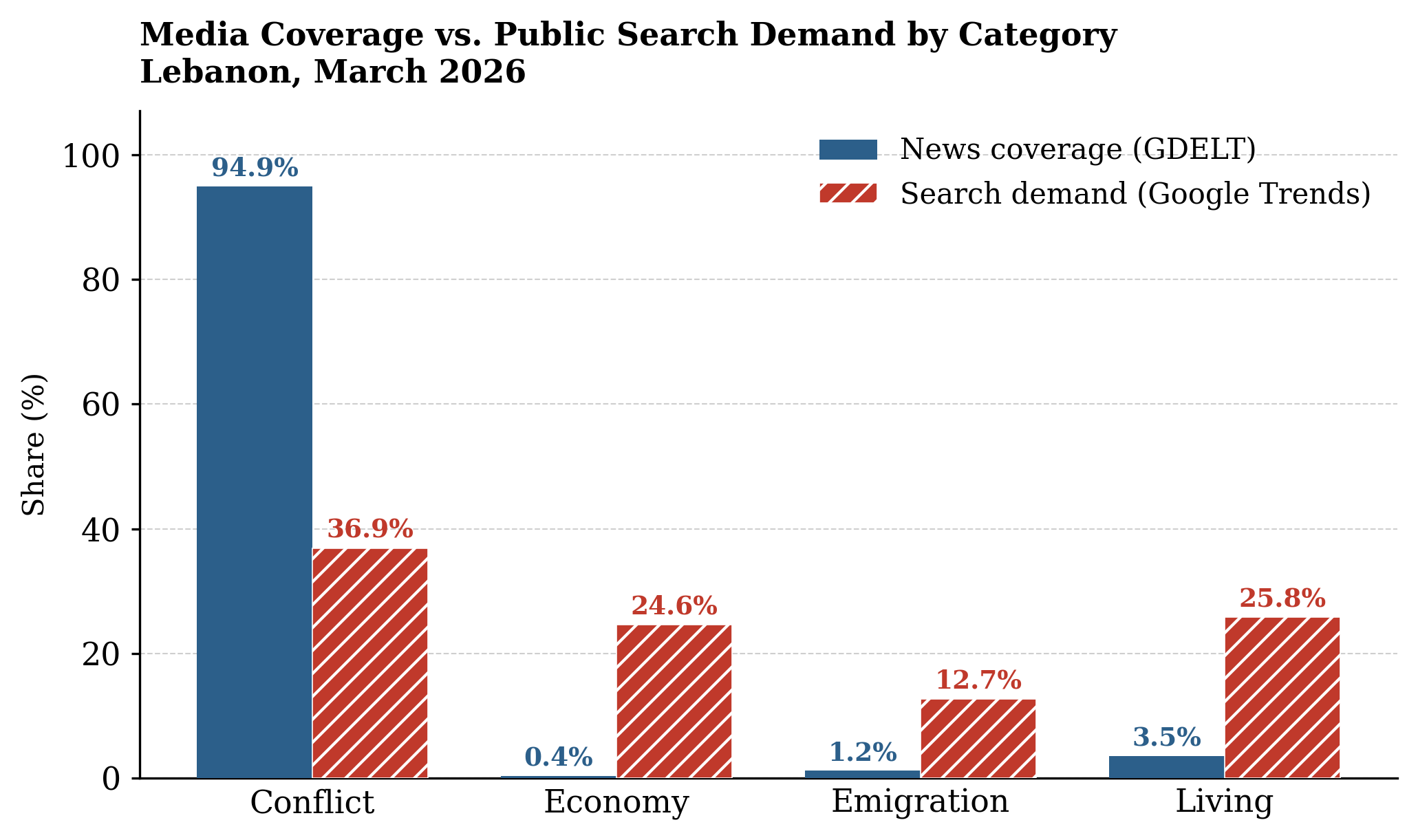
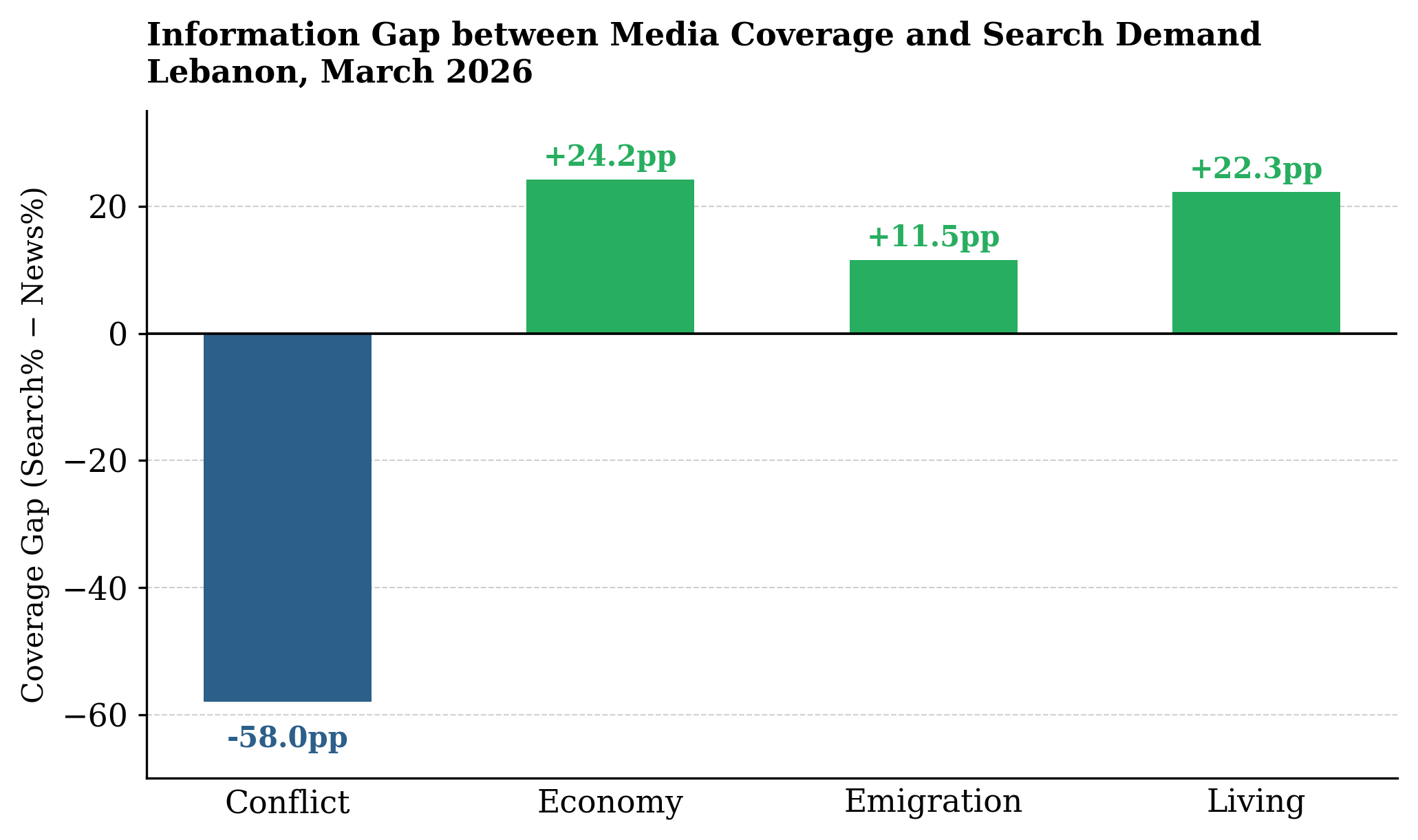
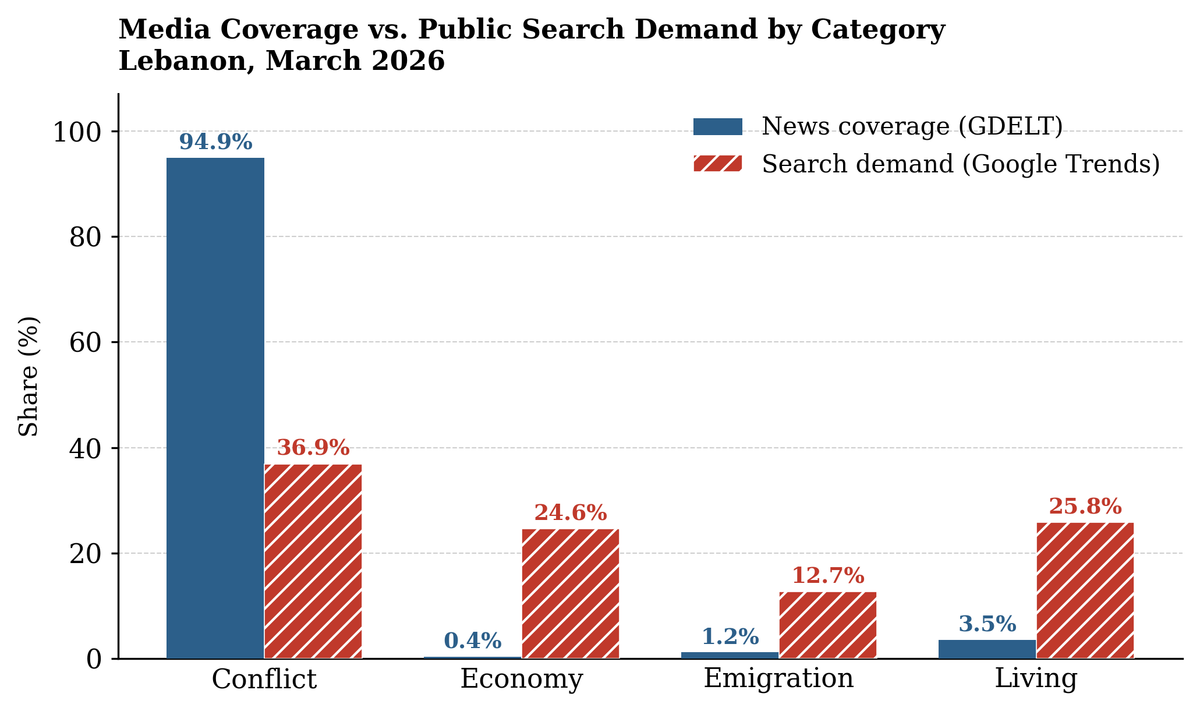
Conflict made up 94.9% of news coverage but only 36.9% of search demand, while economy, living conditions, and emigration accounted for 63.1% of demand but just 5.1% of coverage.
The analysis shows a clear divergence between what media emphasized and what people were actively searching for. While news coverage was almost entirely focused on conflict, public information demand was distributed across economic conditions, daily life, and emigration.
Why This Matters
News coverage focused on the war, but public concern was driven by economic pressure, daily life, and leaving the country.
This gap shows that media reporting captured only part of the reality, while the issues people were actively trying to solve remained largely absent from coverage.
Media Coverage vs Information Demand
This analysis compares how topics are distributed in news coverage versus what people in Lebanon actively searched for during the same period.
Key Findings
The analysis reveals a large imbalance between media coverage and public information demand.
These results show that while conflict dominated media coverage, most information demand was focused on non-conflict concerns.
Time Patterns
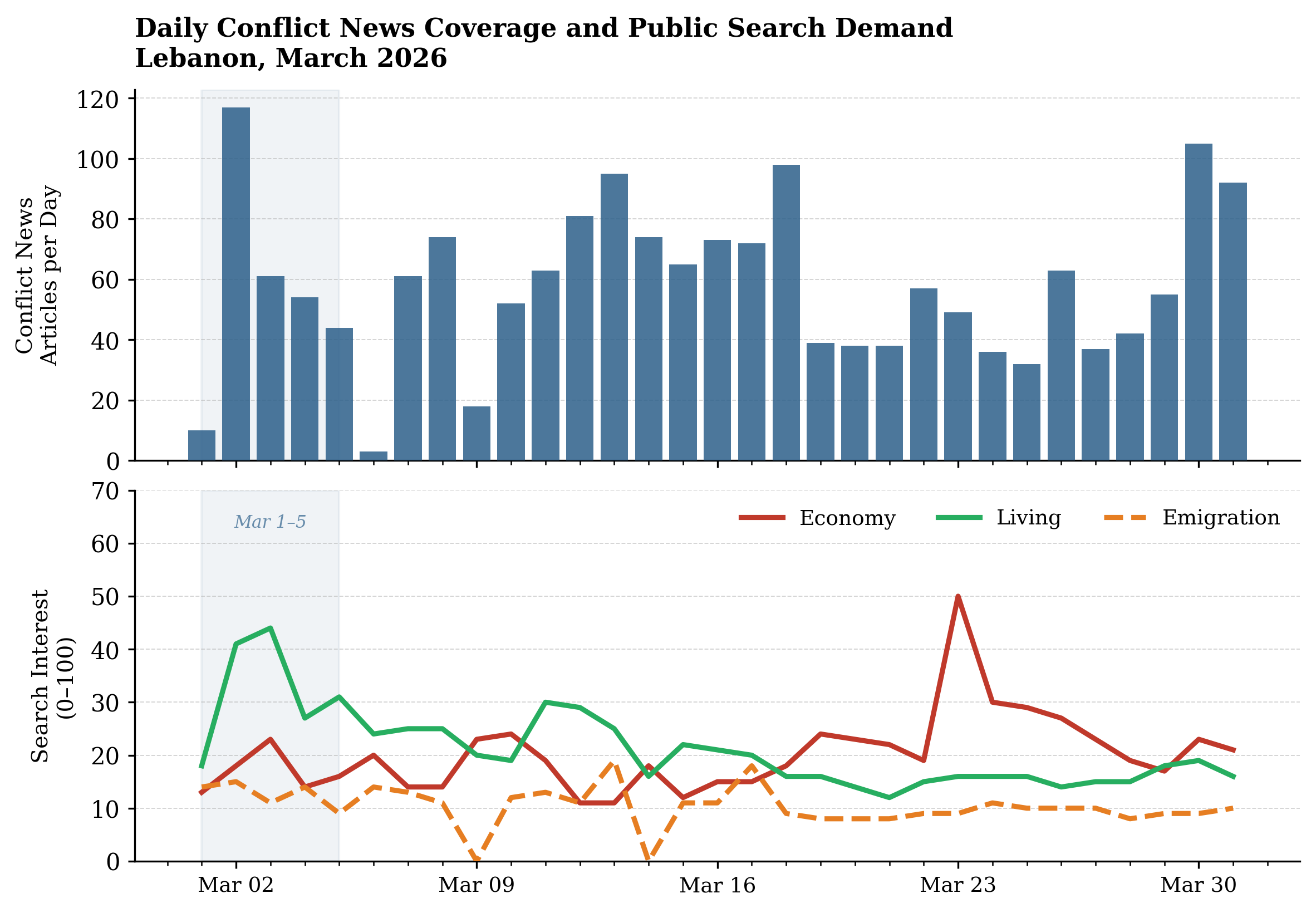
Search demand for economy and living conditions remained consistently high throughout the month, rather than reacting only to major conflict events. This indicates that non-conflict concerns were persistent, not just event-driven.
This suggests that non-conflict information needs were persistent, not just event-driven.
Methodology
Data for this study were collected from two sources: news coverage and Google search data.
News data were collected using the GDELT Document API for all English-language articles mentioning Lebanon between March 1 and March 31, 2026. The initial dataset contained 11,623 articles. After removing duplicates and applying a two-stage relevance filter, 2,428 relevant articles remained.
Headlines were classified into four categories: Conflict, Economy, Living Conditions, and Emigration. Classification followed a fixed priority rule where causes (e.g., airstrikes) were prioritized over consequences (e.g., displacement). A total of 1,894 articles were included in the final analysis.
Public information demand was measured using Google Trends topic data for searches conducted within Lebanon. Four topics were used as proxies: Hezbollah (Conflict), Lira (Economy), Rent (Living Conditions), and Passport (Emigration). These were queried together to allow direct comparison.
The information gap was calculated as the difference between search share and news coverage share for each category.
A validation test on a sample of 100 headlines showed full agreement between model classifications and human annotations. A robustness check excluding the peak conflict period (March 1–5) produced the same overall results.
Source
This page summarizes the research paper:
📃
Measuring the Gap Between Media Coverage and Public Information Demand: Evidence from the 2026 Lebanon Conflict Mohamed Soufan (2026)


 Mohamed Soufan

 Mohamed Soufan
 mohamedsoufan