Uncertainty-Reply Asymmetry Replicates in English X Posts
A replication study finds that the uncertainty-reply asymmetry appears in English-language X posts across Federal Reserve policy, inflation, and electoral politics, suggesting uncertain language may invite more replies than certain statements.

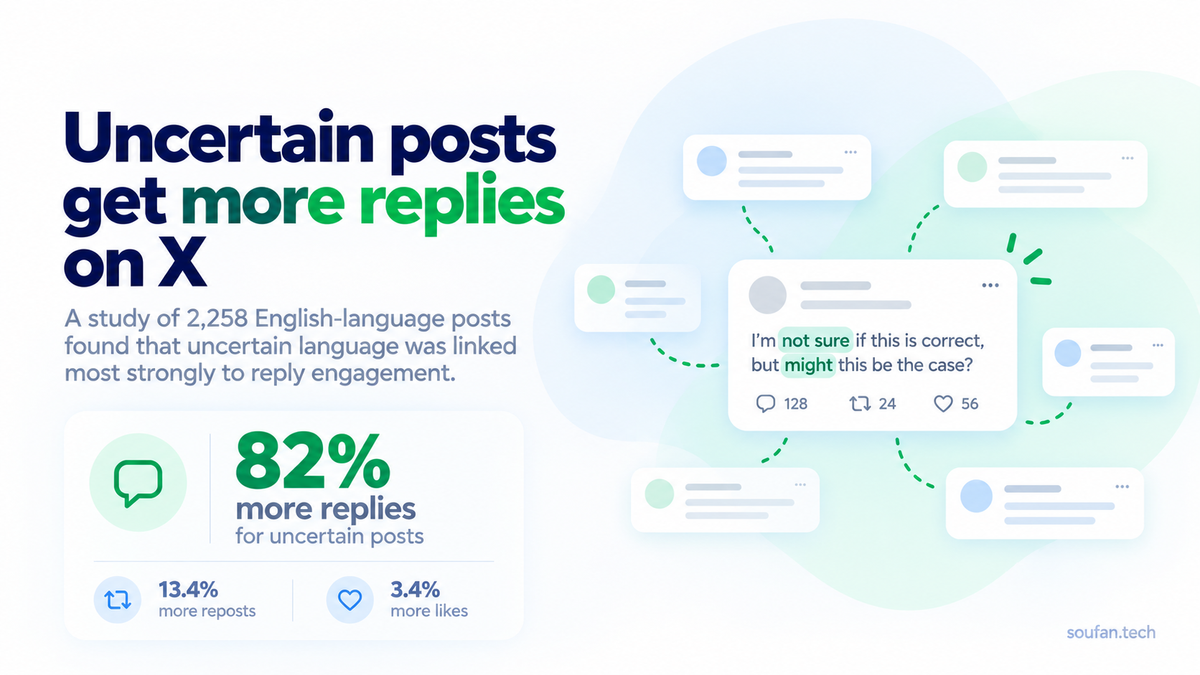
A new study tests whether the uncertainty-reply asymmetry appears in English-language posts on X. The uncertainty-reply asymmetry refers to a pattern where posts expressing uncertainty generate disproportionately more replies than more certain or definitive posts. The phenomenon was previously observed in Arabic-language discourse about Lebanon. This new study examines whether the same pattern appears in English, across different public topics.
Using 2,258 English-language X posts about Federal Reserve policy, consumer price inflation, and electoral politics, the study finds that uncertain posts again received more replies than certain posts. The effect was strongest for replies, weaker for reposts, and weakest for likes.
This suggests that the uncertainty-reply asymmetry may not be limited to Arabic-language discourse or Lebanon-related political discussion. It may reflect a broader pattern in how people respond to uncertainty online.
What the Study Tested
The study examined whether linguistic uncertainty is associated with higher reply engagement on X.
Uncertain language includes expressions of possibility, doubt, incomplete information, or unverified claims, such as “may,” “might,” “unclear,” “not sure,” “reportedly,” “allegedly,” and question-based wording.
The study focused on replies because replies are more conversational than likes or reposts. A like may signal approval, and a repost may signal amplification, but a reply usually requires active participation.
Dataset and Method
The study analyzed posts collected from X between April 8 and April 10, 2026.
The final dataset included:
- 629 posts about Federal Reserve policy
- 934 posts about CPI inflation
- 695 posts about US politics
Posts were classified as uncertain or certain using a lexicon-based uncertainty classifier. Overall, 757 posts, or 33.5% of the dataset, were classified as uncertain.
Key Finding
Across the full dataset, uncertain posts received:
- 82% more replies on average
- 13.4% more reposts
- 3.4% more likes
The largest difference was in replies, which is the main evidence for the uncertainty-reply asymmetry in the English-language dataset.
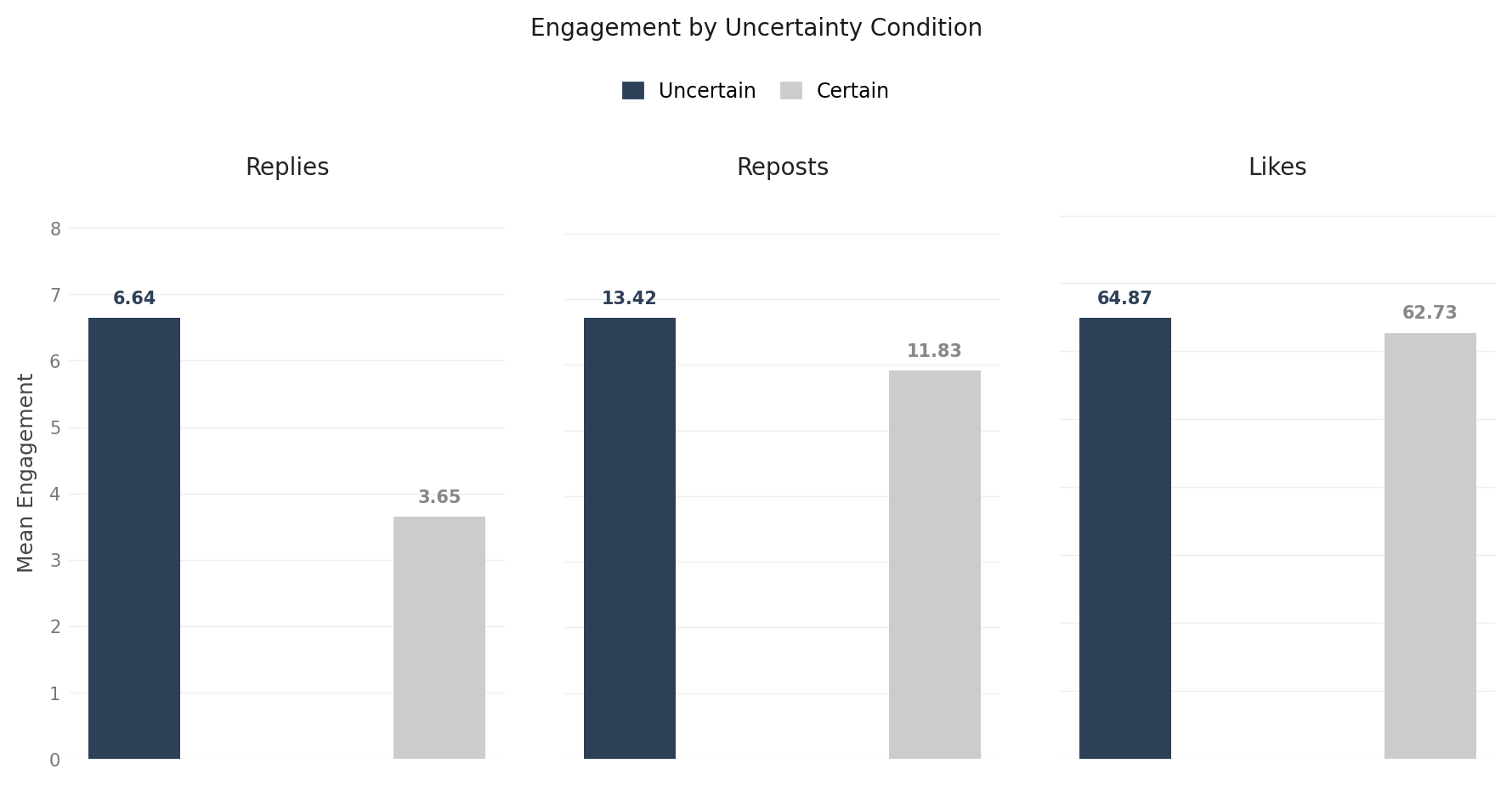
Regression models also supported the finding. After controlling for post length, URL presence, and topic differences, uncertain posts were associated with approximately 13% higher expected reply engagement. The association was statistically significant.
The relationship with total engagement was positive but weaker, suggesting that uncertainty is more strongly linked to conversation than to general popularity.
Why the Replication Matters
This paper is important because it tests whether the uncertainty-reply asymmetry generalizes beyond the first Arabic-language study.
The earlier study focused on Arabic-language tweets about Lebanon. This study tests the same phenomenon in English across three different domains: monetary policy, inflation, and electoral politics.
The replication strengthens the case that uncertainty-reply asymmetry is not only a feature of one language, one country, or one political context. Instead, uncertain language may act as an interactional cue that makes posts more likely to receive replies.
Limitations
The study is observational, so it shows association rather than definitive causation.
The classifier is also rule-based. This makes the method transparent and interpretable, but it may miss subtle forms of uncertainty that do not use explicit uncertainty markers.
For that reason, the reported effects should be understood as conservative estimates.
Conclusion
This study provides English-language evidence for the uncertainty-reply asymmetry.
The findings extend the uncertainty-reply asymmetry beyond the original Arabic-language study and suggest that uncertain language may play a broader role in shaping online conversation. In this English-language replication, uncertainty was most strongly associated with replies, supporting the idea that uncertain posts are more likely to invite participation than passive engagement.
The findings extend the uncertainty-reply asymmetry beyond the original Arabic-language study and suggest that uncertain language may play a broader role in shaping online conversation.
Source
This article summarizes the research paper:
Mohamed Soufan (2026)
Full paper on arXiv
 Mohamed Soufan
Media & Contact
For media inquiries or interviews about this research, please use the contact page.