Lebanon news focuses on war, people search economy
94.9% of Lebanon news coverage focused on conflict, but only 36.9% of search demand did. Most searches centered on economy, living, and emigration.


During the Lebanon conflict in March 2026, 94.9% of international news coverage focused on conflict—while only 36.9% of public search demand did.
In an analysis of 1,894 English-language news articles, conflict accounted for 94.9% of total coverage. By contrast, Google search data shows that conflict represented only 36.9% of public information demand.
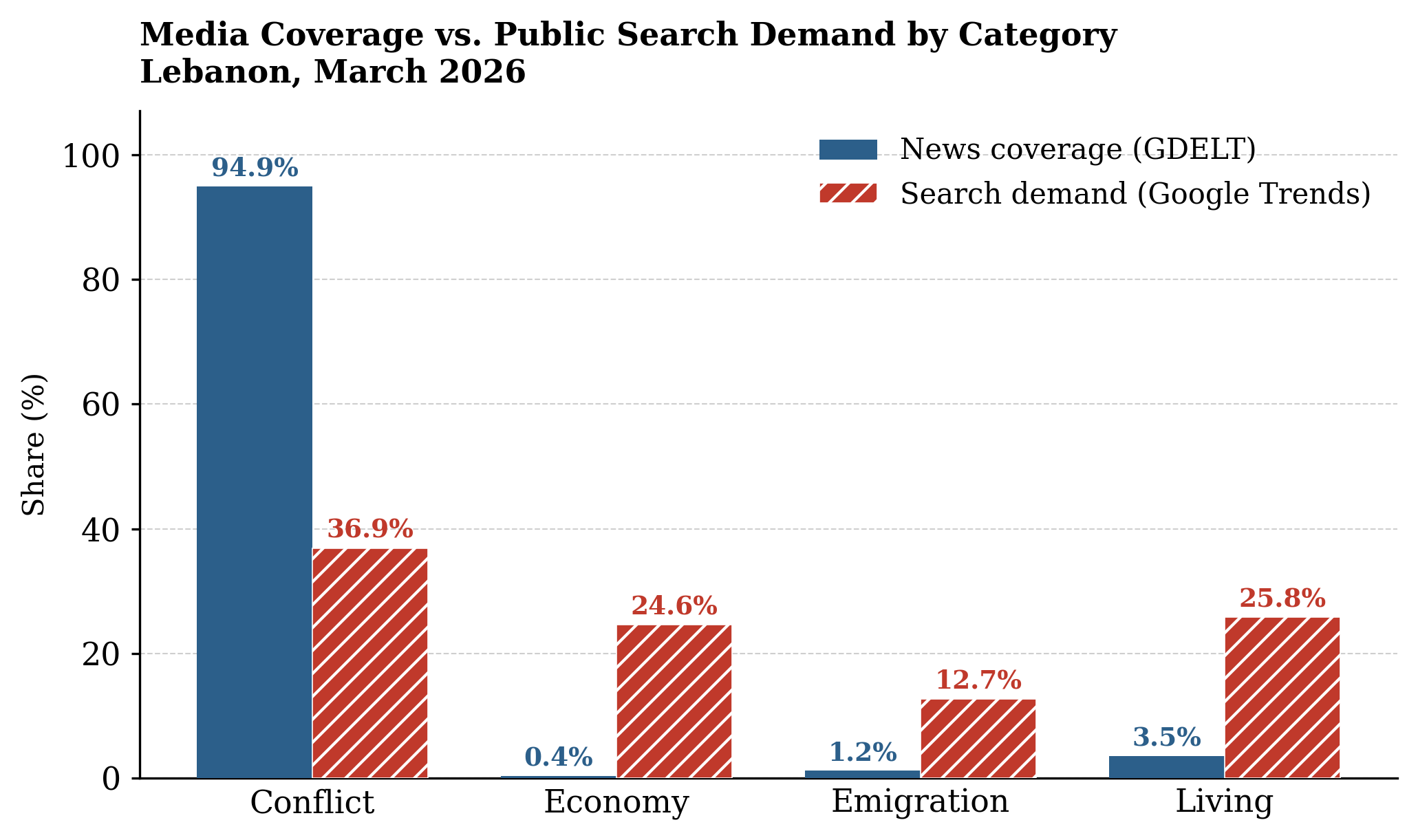
Instead, most search activity focused on everyday survival concerns. Topics related to the economy, living conditions, and emigration together made up 63.1% of total search demand, despite receiving just 5.1% of media coverage.
The gap is especially visible in specific categories:
- Economy: 0.4% of coverage vs 24.6% of search demand
- Living conditions: 3.5% vs 25.8%
- Emigration: 1.2% vs 12.7%
This reveals a clear gap between what is reported and what people seek.
Why this matters
The findings highlight a broader issue in conflict reporting: media coverage may capture the most visible events, but not necessarily the full range of public concerns.
During March 2026, the information environment in Lebanon appears to have been split between:
- A media agenda centered almost entirely on war
- A public demand spread across survival, stability, and exit options
This gap suggests media coverage failed to reflect the real priorities of people in Lebanon during the conflict.
What the data shows
The analysis combines two large-scale datasets:
- News articles collected from the GDELT database (March 1–31, 2026)
- Google Trends data reflecting search activity within Lebanon over the same period
News headlines were filtered for relevance and classified into four categories: conflict, economy, living conditions, and emigration. Public demand was measured using Google Trends topics (e.g., “Hezbollah,” “Lira,” “Rent,” “Passport”) to capture real-time information-seeking behavior across languages.
To ensure reliability, a sample of headlines was independently reviewed by human annotators, showing full agreement with automated classification.
Methodology
This analysis compares 1,894 English-language news articles from the GDELT database (March 2026) with Google Trends search data from within Lebanon over the same period. Headlines were classified into four categories (conflict, economy, living conditions, emigration), and search demand was measured using topic-level data (e.g., “Hezbollah,” “Lira,” “Rent,” “Passport”) to capture real-world information-seeking behavior across languages.
Related Research
 Mohamed Soufan
 Mohamed Soufan
Lebanon’s Crisis Communications Often Lacked Clear Guidance – OpEd
Data and code available on GitHub
mohamedsoufan
arXiv paper
Mohamed Soufan
Media & Contact
For media inquiries or interviews about this analysis, please use the contact page.