Attention Concentration in Online Political Discussions on X
This study analyzes engagement in online political discussions on X and finds that attention is highly concentrated, with a small number of users receiving most engagement.


Online political discussions on social media often appear highly participatory, with thousands of users posting, commenting, and reacting to events. However, participation does not necessarily mean attention is evenly distributed. While many users contribute to discussions, a much smaller number of accounts often receive most of the engagement.
This study analyzes Arabic-language political discussions on X (formerly Twitter) to examine how attention and engagement are distributed across users.
The top 1% of users received more than 60% of total engagement.
The analysis shows that the top 1% of users received more than 60% of total engagement, while the vast majority of users received very little attention. These findings indicate that online discussions may appear broadly participatory, but attention is highly concentrated among a small number of accounts.
Participation vs Attention
Social media platforms create the impression that many voices are participating equally in public discussions. Thousands of users may post about the same topic, giving the appearance of a broad and open conversation.
However, participation and attention are not the same. Many users may post, but only a small number of accounts receive most of the likes, reposts, and replies. This creates a structure where discussions appear democratic in participation but concentrated in attention.
This study measures attention concentration by examining how engagement is distributed across users participating in the same political discussion.
Key Findings
The analysis reveals a highly concentrated distribution of engagement in Arabic-language political discussions on X.
Main Results
- Dataset size: 15,767 Arabic-language posts
- Number of users: 8,148
- Collection period: One week
- Top 1% of users received about 61.5% of total engagement
- Top 5% of users received about 90.6% of total engagement
- Top 10% of users received about 96.2% of total engagement
The distribution of engagement across top users is shown in the figure below.
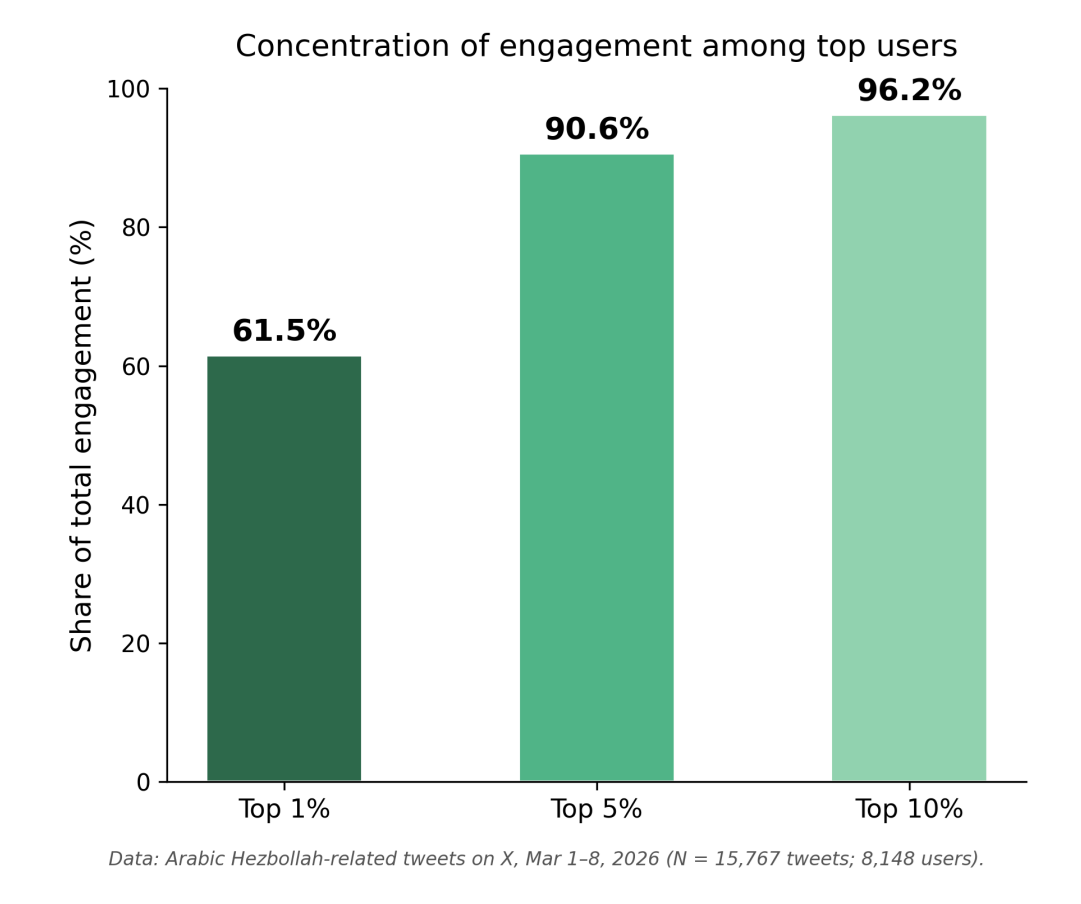
These results show that while many users participate in discussions, engagement and attention are heavily concentrated among a small number of accounts.
Why This Matters
Understanding how attention is distributed on social media is important for studying online political communication and public debate. Social media platforms are often described as spaces where everyone can participate and express opinions. While participation may be widespread, attention is not evenly distributed.
If a small number of accounts receive most engagement, they may have disproportionate influence over what information spreads and which narratives become visible. This means that online discussions may appear broadly participatory, but attention and influence may be concentrated among a small number of users.
These findings suggest that social media discussions may be better understood not only in terms of participation, but also in terms of attention distribution and visibility.
Methodology
Data for this study were collected from X (formerly Twitter) using automated data collection tools and Arabic-language search queries related to political discussions. The dataset includes 15,767 original Arabic-language posts from 8,148 users collected over a one-week period.
Engagement was measured as the combined total of likes, reposts, and replies. Users were ranked by total engagement received, and the distribution of engagement was analyzed to measure how attention was concentrated across users.
Additional statistical analysis and robustness checks are reported in the full paper.
Source
This page summarizes the research paper:
Mohamed Soufan (2026)
Full paper on arXiv.
A shorter analysis of the main finding is also available here.
An earlier version of this analysis was published as an op-ed on Eurasia Review, highlighting the concentration of attention and the dominance of a small group of users in shaping online political discussions.
Media & Contact
For media inquiries or interviews about this research, please use the contact page.