Lebanon Strike Mentions Jump 5× Pre-Ceasefire
Analysis of 5,142 posts on X shows strike reports surged before the ceasefire announcement and remained elevated during it.


After the ceasefire announcement affecting Lebanon on April 8, discussion surged on X. We analyzed 5,142 posts collected over ~24 hours (Apr 7–8, 2026) to understand how conflict-related narratives evolved in real time.
Reports of new strikes in Beirut are emerging. Earlier data showed strike reports surged to 5× above baseline before the ceasefire.
Key finding: Early signals of escalation appeared on X before the ceasefire announcement.
What the data shows
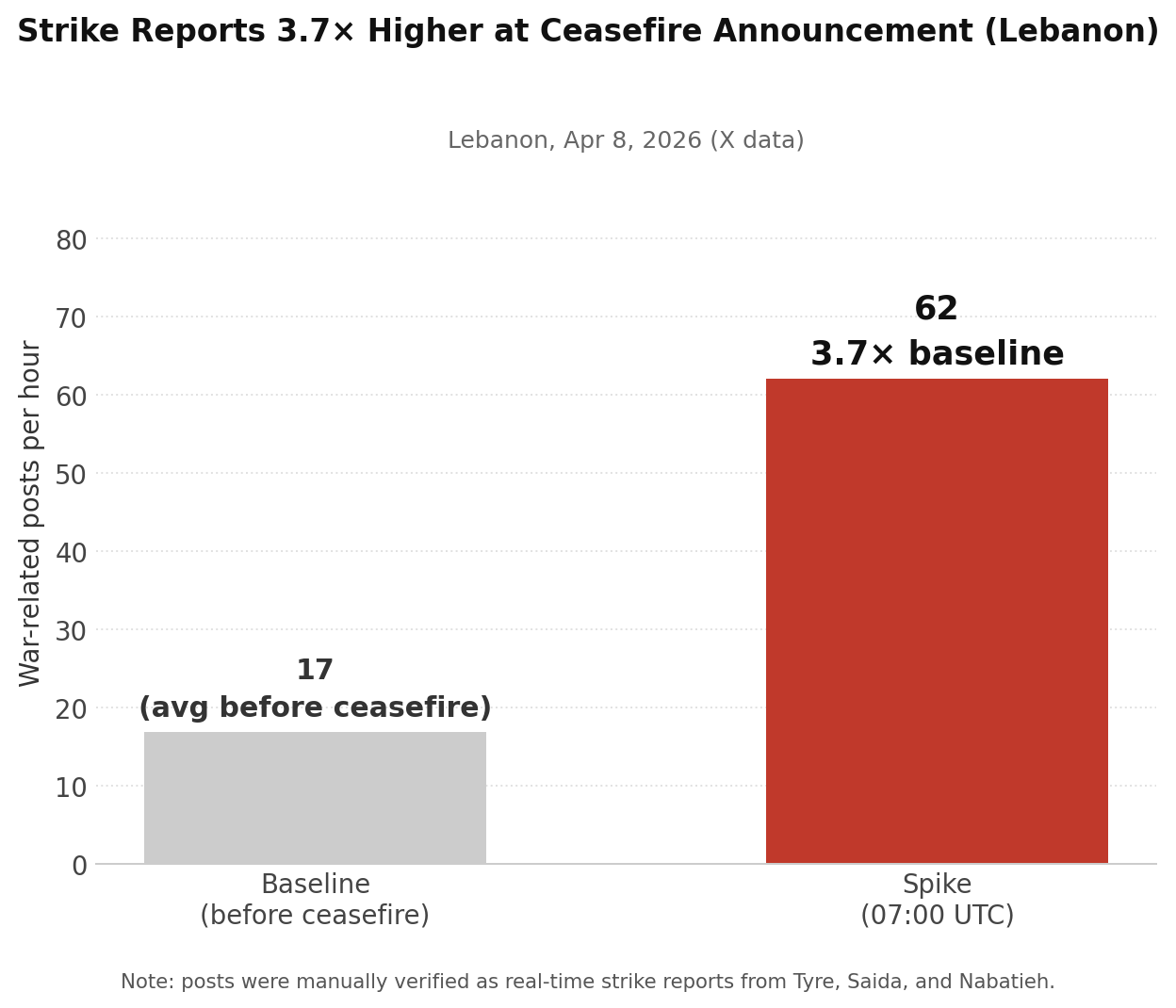
- Baseline: 16.9 posts/hour before the ceasefire
- 06:00 UTC: 85 posts/hour (5.0× higher) — peak before announcement
- 07:00 UTC: 62 posts/hour (3.7× higher) — announcement hour
- 08:00 UTC: 36 posts/hour (2.1× higher)
All posts in the spike hours were manually verified as real-time, location-specific reports from Tyre, Saida, Nabatieh, and nearby areas.
What people posted and paid attention to
Strike reports increased sharply before the announcement and remained elevated during and after it.
At the same time, the overall conversation shifted strongly toward ceasefire narratives, which accounted for around 80% of posts during and after the announcement hour.
This shows that while attention moved toward the ceasefire, reports of ongoing strikes continued circulating at elevated levels.
How narratives changed over time
The timeline shows a clear pattern: conflict-related posts peaked before the announcement and remained elevated during it.
This indicates that online discussion reflected both real-time developments on the ground and the official ceasefire narrative simultaneously, rather than shifting cleanly from one to the other.
Detailed Findings
- Strike reports peaked before the ceasefire announcement (5.0× baseline)
- They remained elevated during the announcement hour (3.7×) and after (2.1×)
- Posts were verified as real-time, location-specific reports from south Lebanon
- Ceasefire narratives dominated overall discussion (~80% of posts)
- Conflict reporting persisted alongside the ceasefire narrative
Data and Methodology
Posts were collected from X using keyword-based searches focused on Lebanon-related conflict discussion between April 7 and April 8, 2026.
After removing duplicates and irrelevant content, the final dataset included 5,142 posts.
Posts were classified using a rule-based approach, with manual verification applied to spike periods.
Post volume was aggregated by hour to measure changes before, during, and after the ceasefire announcement.
Conclusion
Online discussion did not follow a simple shift from conflict to ceasefire.
Instead, posts reporting strikes surged before the announcement and remained elevated during it, while ceasefire narratives dominated the broader conversation.
This highlights a key dynamic of online discourse during fast-moving events: real-time information and official narratives can coexist and spread simultaneously.
Related Research
 Mohamed Soufan
Media & Contact
For media inquiries or interviews about this analysis, please use the contact page.