Lebanon Coverage Focused on Politics Over Civilians
Analysis of 113 news articles shows coverage emphasized diplomacy and military developments over humanitarian impact following the Beirut strikes.

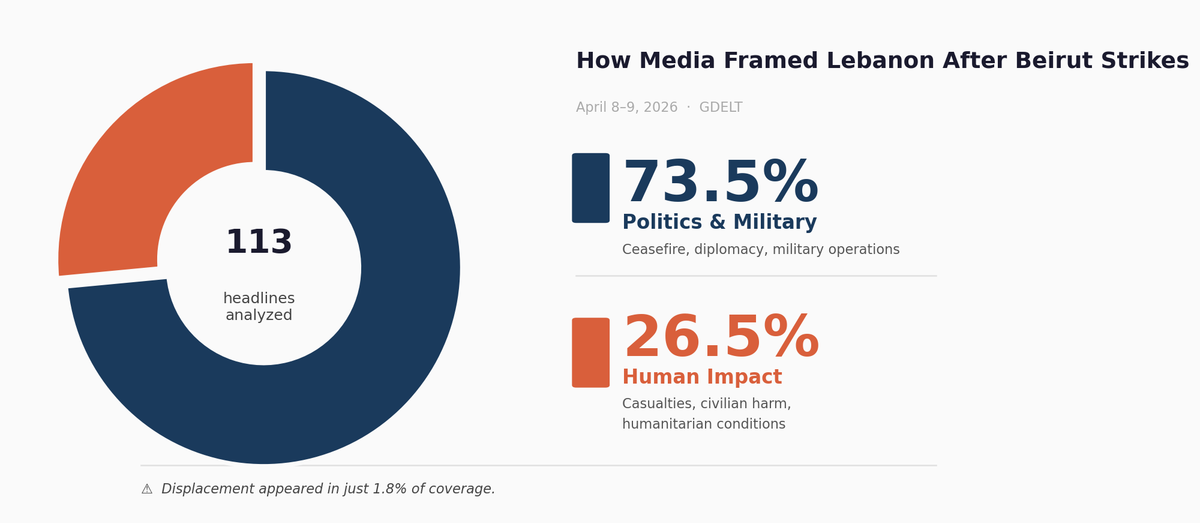
After Israeli strikes hit Beirut on April 8, 2026, media coverage surged. We analyzed 113 English-language news headlines collected via the GDELT Project (April 8–9, 2026) to examine how the event was framed: as a human crisis, or as a political and military story.
What the data shows
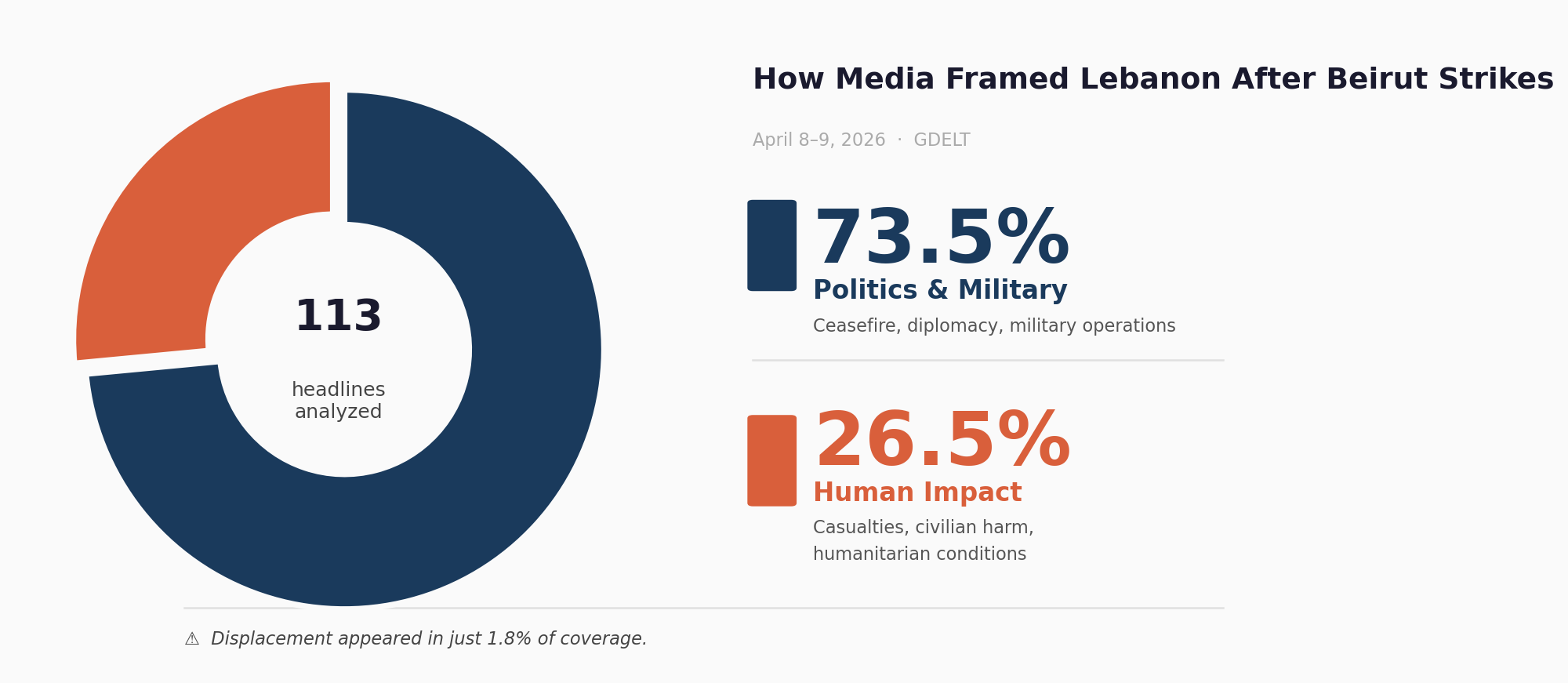
- 113 headlines analyzed (April 8–9, 2026)
- 83 articles (73.5%) — politics and military framing (ceasefire, negotiations, Hezbollah, military developments)
- 30 articles (26.5%) — human impact (casualties, civilians, humanitarian conditions)
- 2 articles (1.8%) — mentioned displacement, both framed around evacuation warnings rather than civilian flight
Despite mass civilian casualties reported on April 8, coverage remained dominated by political and military narratives.
What the coverage focused on — and what it didn’t
The dominant narrative across outlets was political: whether Lebanon was included in the US-Iran ceasefire deal, Israel’s position on continuing operations, and Hezbollah’s role. Headlines such as “Netanyahu says Trump ceasefire deal does not include Lebanon as strikes continue” and “Vance says Lebanon was never part of US-Iran cease-fire deal” were representative of the majority.
Human impact coverage—where it appeared—focused almost entirely on casualty counts. Headlines like “Lebanon health ministry says Israeli strikes killed 182” and “Nearly 100 killed and over 800 wounded in single day of Israeli strikes on Lebanon” did appear, but accounted for fewer than 1 in 4 articles.
What was largely absent was displacement. No headline in the dataset led with refugees, shelters, or fleeing populations. The few references to evacuation appeared in the context of military warnings, not civilian experience.
How framing held across source regions
The pattern was not limited to any single media tradition. When the dataset was split by source region, the same imbalance appeared across all groups.
Middle Eastern outlets (including Israel, Syria, Turkey, and Egypt) showed 77% political and military framing, with 23% focused on human impact.
Western outlets (US, UK, Australia, Canada) showed relatively more attention to human impact, but still remained majority political, with 65% political framing and 35% human impact.
Other international outlets (including India and Bangladesh) showed the strongest skew, with 81% political framing and 19% human impact.
Despite differences in geography and proximity to the conflict, all regions converged on the same pattern: coverage was consistently framed through political and military narratives rather than humanitarian impact.
Detailed Findings
- 73.5% of verified headlines framed the Lebanon story through a political or military lens
- 26.5% focused on human impact, primarily casualty figures
- Displacement — refugees, shelters, fleeing civilians — appeared in 1.8% of all coverage (2 of 113 articles)
- The political dominance held across all source regions: Middle Eastern (77% B), Western (65% B), Other (81% B)
- 101 of 113 articles (89%) were published on April 8 itself, confirming the dataset captures the acute post-attack media response
- Top source countries: United States (23), Israel (17), India (15), Syria (11), United Kingdom (8), Turkey (6), Australia (5), Egypt (4)
- The single most repeated story frame: whether Lebanon was included or excluded from the US-Iran ceasefire deal
Data and Methodology
Headlines were collected from the GDELT Project’s Document 2.0 API — a publicly accessible index of English-language news content — using two keyword queries: Lebanon and Beirut, filtered to sourcelang:english. The collection window ran from April 8, 2026, 00:00 UTC to April 10, 2026, 23:59 UTC.
To prevent API truncation (250 articles per request), the window was divided into 1-day sub-windows, with recursive splitting into 12-hour and 6-hour windows when the cap was reached. Requests were spaced at least 8 seconds apart, with exponential backoff applied to rate-limit responses. Deduplication was performed using both URL and normalized headline across queries.
The raw yield of 528 articles was reduced to 113 through three cleaning steps:
(1) retaining only headlines explicitly naming Lebanon or Beirut;
(2) removing references to U.S. locations named Lebanon;
(3) excluding articles focused on commodity markets or Strait of Hormuz shipping rather than the Lebanon conflict.
Each article was manually classified into one of two categories — A (Human Impact) or B (Politics and Military) — based on the dominant framing of the headline. Classification was applied at the headline level using a single rule: what is this headline primarily about? Mixed cases were resolved by identifying the grammatical subject and primary action. No automated scoring or keyword-based classification was used.
A 65% publication threshold was defined prior to analysis to determine a clear imbalance. The observed split of 73.5% vs 26.5% exceeds this threshold.
The full dataset and analysis code are publicly available on GitHub.
Conclusion
English-language media coverage of Lebanon in the 72 hours following the April 8 strikes was overwhelmingly political in frame. Nearly three in four headlines focused on ceasefire negotiations, Israel's strategic positioning, and diplomatic responses — not on the civilians killed, wounded, or displaced by the strikes themselves.
The near-total absence of displacement coverage is the sharpest finding. On a day when 182 people were killed in Beirut and Israeli forces ordered evacuations of southern suburbs, fewer than 2% of headlines led with the movement or conditions of affected civilians.
This is not a finding about what happened — it is a finding about what was considered worth framing as the story. The political architecture of the ceasefire debate crowded out the human cost of its absence.
Related Research
 Mohamed Soufan
 Mohamed Soufan
A version of this analysis was published as an op-ed on Eurasia Review.
Read it here.
Media & Contact
For media inquiries or interviews about this analysis, please use the contact page.