Inside the Hidden Structure of Political Discourse on X
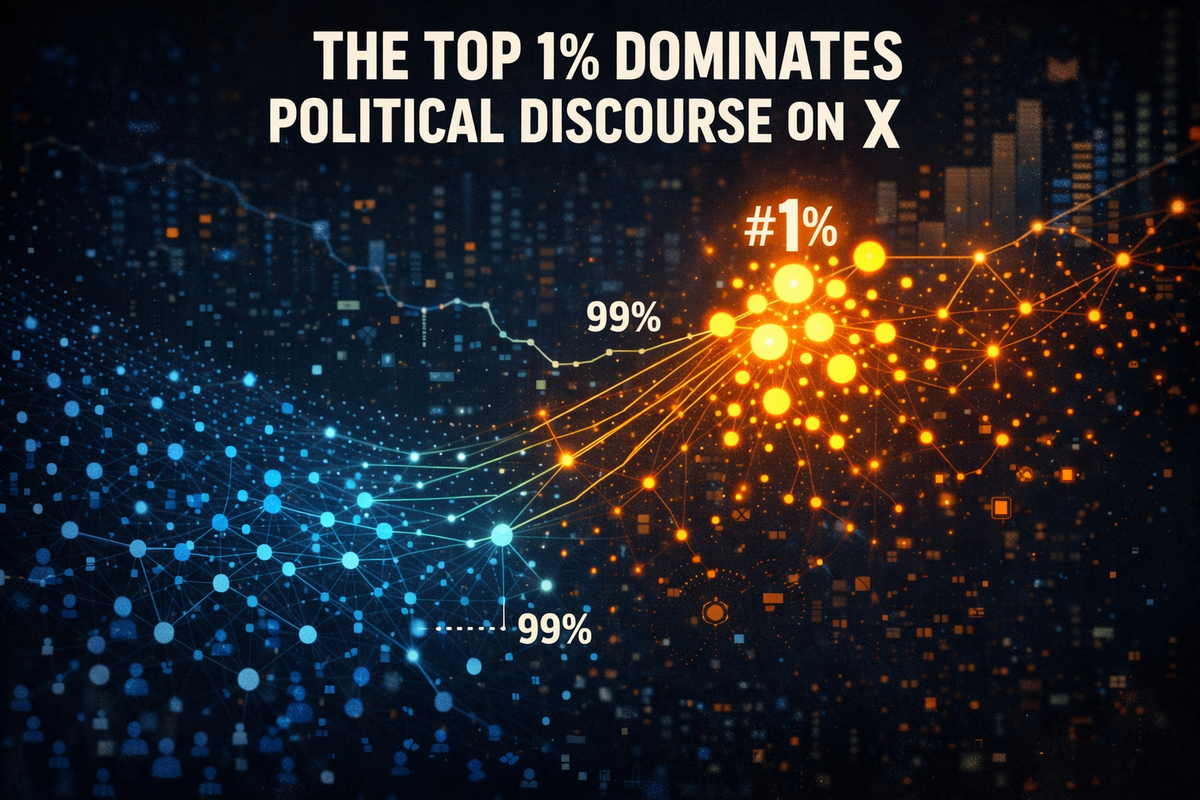
A study of Arabic-language political discussions on X shows that while thousands participate, attention is highly concentrated—just 1% of users drive over 60% of engagement.

Online political discussions often look highly participatory. Thousands of users post, comment, and react, creating the impression of a broad and open conversation.
But participation is not the same as attention.
While many users contribute, only a small fraction receive meaningful engagement.
This creates a gap between appearance and reality: discussions look widespread, but visibility is concentrated. As a result, what appears to be collective opinion is often shaped by a small minority.
What the data shows
The analysis is based on 15,767 Arabic-language posts from 8,148 users collected over a one-week period of political discussion on X.
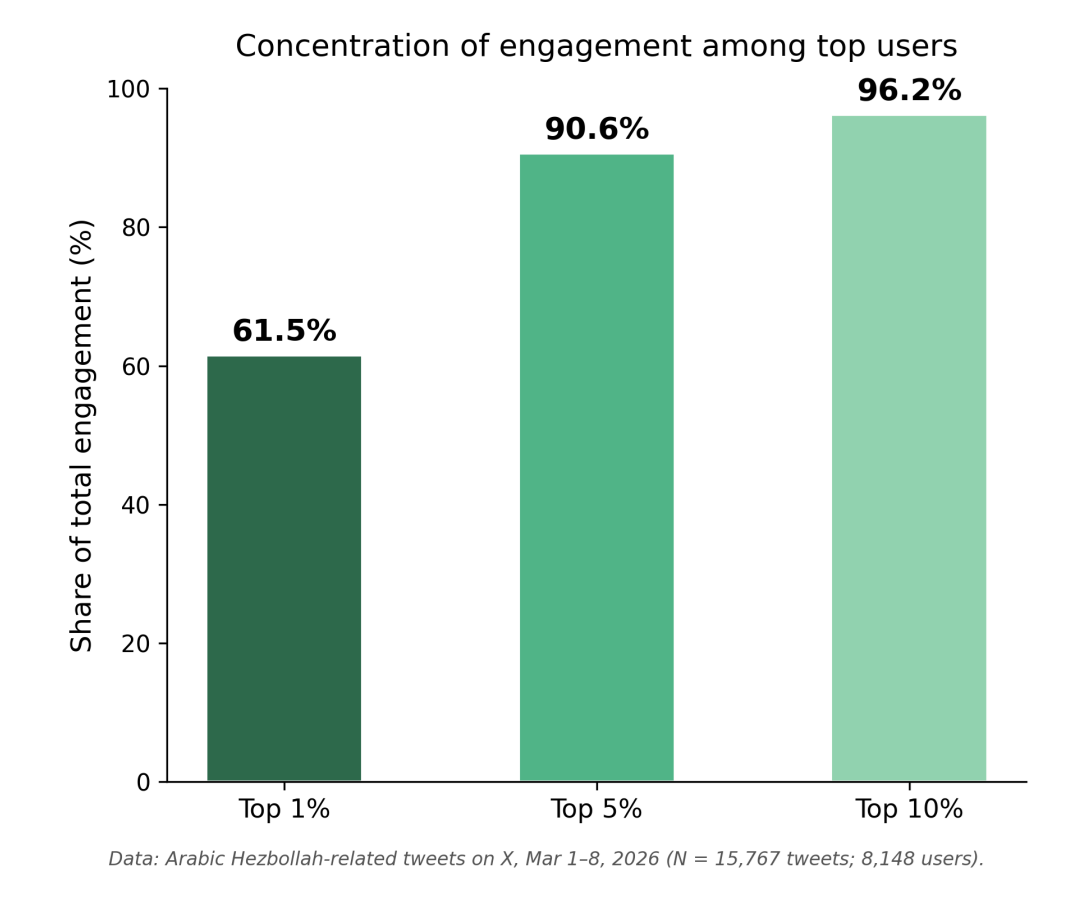
The results show a highly concentrated distribution of attention: the top 1% of users received more than 60% of total engagement. The top 5% captured over 90%, and the top 10% nearly all engagement.
In contrast, the vast majority of users received little to no interaction on their posts.
The 1% That Shapes Visibility
Just 1% of users received more than 60% of all engagement.
This means that a handful of accounts consistently attract the majority of likes, reposts, and replies, shaping what others see and interact with.
As a result, the flow of attention—and the narratives that gain traction—is heavily influenced by this top 1%.
Engagement is not representation
High engagement is often interpreted as a signal of importance or popularity. Posts that receive more likes, reposts, and replies are seen as representing what people think or care about.
But engagement does not equal representation.
When attention is concentrated among a small group of users, the most visible content reflects the activity of that group—not the broader population.
This creates a distortion: what appears to be widely supported may simply be highly amplified.
What this means for Lebanon
In the Lebanese context, where political narratives are already contested, this concentration of attention has clear implications.
Online discussions often appear to reflect broad public sentiment, but in reality, a small group of highly visible accounts can shape which narratives dominate.
For journalists, analysts, and policymakers, this creates a risk of misreading the public mood. High engagement around certain topics or viewpoints may reflect amplification rather than widespread support.
As a result, understanding who receives attention becomes just as important as understanding who participates.
Rethinking online public opinion
Online discussions are often used as a proxy for public opinion.
But when attention is concentrated, these signals become unreliable.
A large volume of posts does not mean broad influence, and high engagement does not mean widespread agreement.
To better understand online discourse, the focus needs to shift—from how many people participate to how attention is distributed.
Conclusion
Online political discussions are not as open as they appear. While many participate, attention is concentrated among a small minority that shapes what is seen and what spreads.
Understanding this gap is essential. Without it, visibility can be mistaken for representation—and a few voices are misread as the many.
Read the Full Paper
This article is based on a larger computational study of Arabic-language political discourse on X (Twitter), examining how attention and engagement are distributed across users.
A summary of the paper is available on my website, with additional details on methodology, dataset construction, and statistical analysis.
The full paper is published on arXiv for academic access.
An earlier version of this analysis was published as an op-ed on Eurasia Review, highlighting the concentration of attention and the dominance of a small group of users in shaping online political discussions.
Media & Contact
For media inquiries or interviews about this research, please use the contact page.