Narratives beat news on X after Lebanon ceasefire
A data analysis of 1,442 Arabic-language posts on X shows that after Lebanon’s ceasefire, attention focused on repeated narratives and a small group of accounts, not on ground-level reporting.

When Lebanon’s ceasefire took effect in April 2026, Arabic-language users on X flooded the platform with updates — explosions in the south, troop movements, reported violations, and official statements.
But the data tells a different story.
Much of what spread in the first 48 hours was not new reporting. It was repeated narratives.
An analysis of 1,442 posts collected between April 16 and 18 found three clear patterns: the conversation was repetitive, engagement was highly concentrated, and ceasefire updates drew far more attention than reports of violations on the ground.
One in three posts repeated the same claims
Of the 1,442 posts analyzed:
In total, 1,074 distinct claim clusters were identified, but only 144 included more than one post. Most content appeared once. A smaller set of narratives was repeated across multiple accounts.
The largest cluster, with 25 posts, centered on a single claim: Iran’s Foreign Minister announcing that the Strait of Hormuz would remain open following the Lebanon ceasefire. The same statement spread across news outlets, commentary accounts, and political pages, with little variation.
Ceasefire updates drew more attention than violation reports
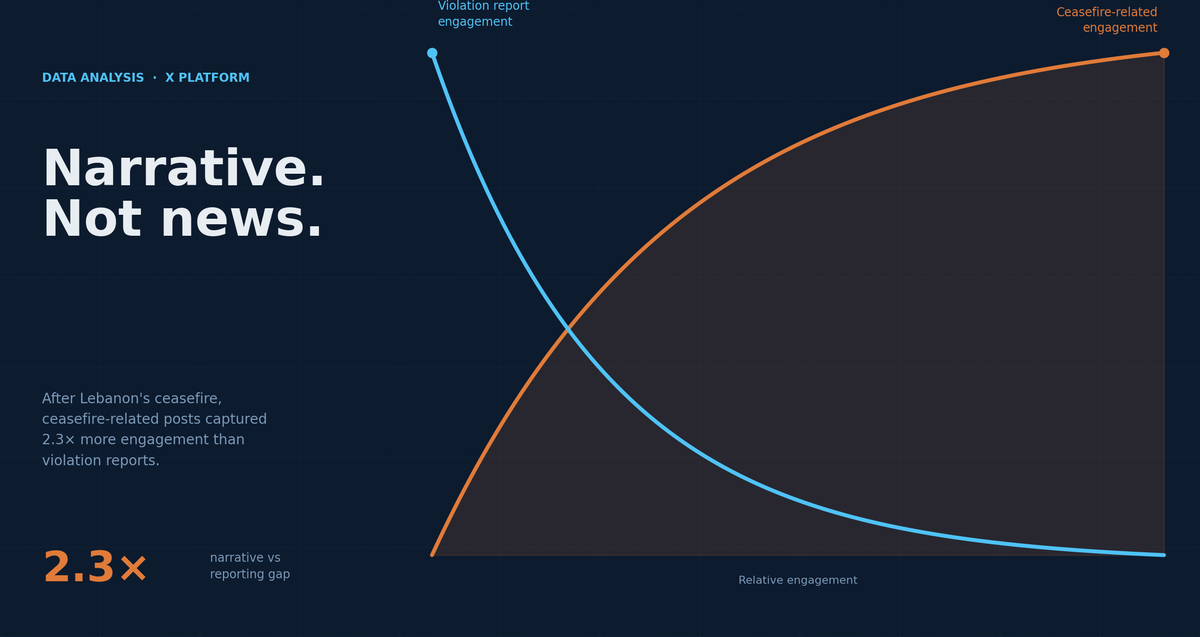
It is often believed that dramatic content — shelling, airstrikes, or ceasefire violations — gets the most attention. But the data shows something different.
Posts about violations on the ground accounted for just 28.6%.
That is a gap of nearly 2.3×.
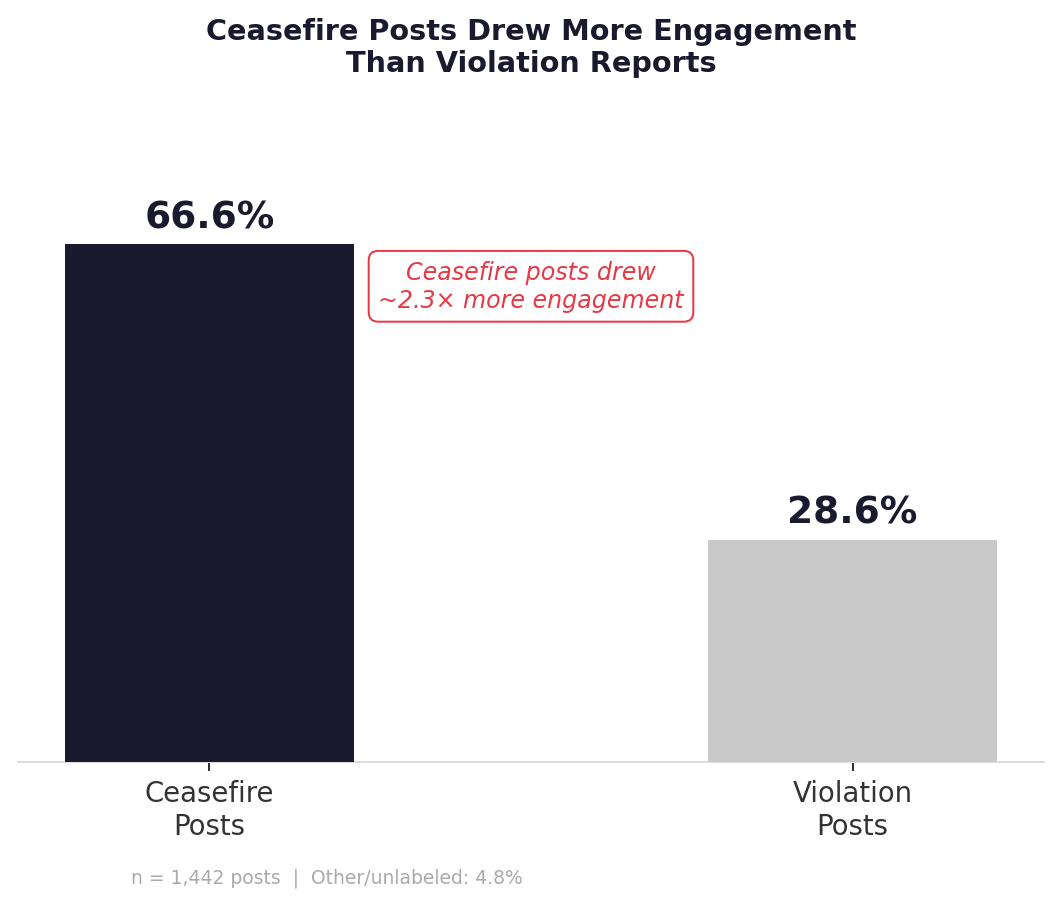
The difference appears at the cluster level as well. Ceasefire clusters averaged 222 interactions per cluster, while violation clusters averaged 118.
The data does not fully explain why, but the pattern is clear. The highest-engagement clusters were driven by large announcements and political reactions — such as the Saudi Foreign Ministry welcoming the ceasefire, Iran-related developments, and commentary on Hezbollah’s role.
Many violation reports came from multiple outlets using similar wording and drew little engagement.
40 accounts drove 60% of all Engagement
Attention was highly concentrated. Out of roughly 800 accounts in the dataset, the top 5% — just 40 accounts — generated 60.8% of all engagement. The remaining 95% accounted for 39.2%.
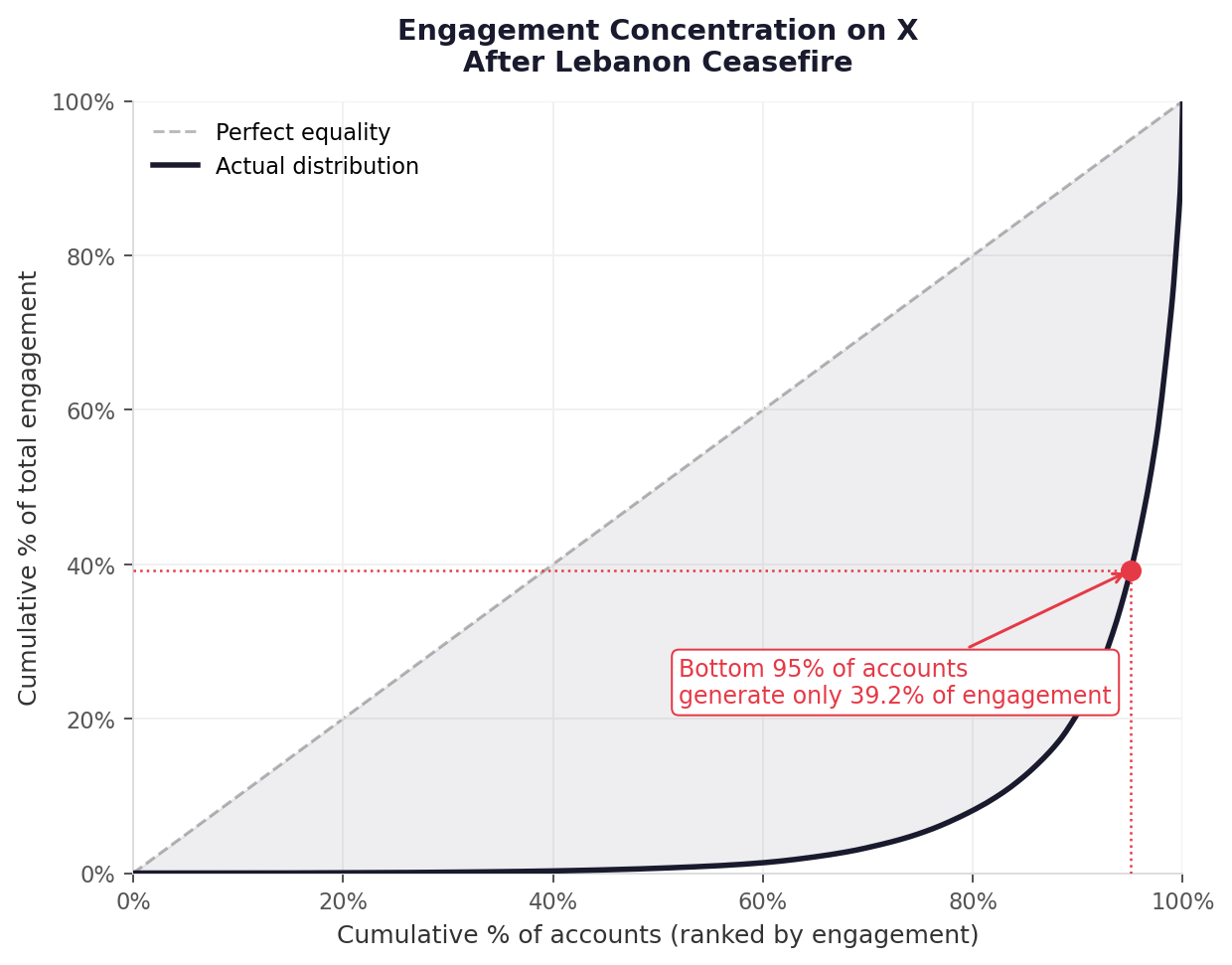
A closer look at the highest-engagement clusters shows that none were led by traditional media outlets. Instead, the top-performing posts came from political commentators, influencer accounts, news aggregators, and official government profiles such as the Saudi Ministry of Foreign Affairs.
Media reporting vs what people engaged with
The contrast with newsroom reporting is stark.
One cluster included posts from 18 Lebanese media outlets — including MTV Lebanon, Future TV, NBN, Al-Jadid, and the National News Agency — all reporting the same shelling near Al-Qantara in Marjayoun. Eighteen outlets, one verified event.
Total engagement: 26 interactions.
The media reported. The audience barely engaged.
What the top clusters looked like
The five highest-engagement clusters in the dataset show where attention actually went.
- Cluster 1 — 15,458 engagement: A mix of posts from a small number of pro-Hezbollah and pro-Iran commentary accounts, covering multiple aspects of the ceasefire moment — Trump’s role, Iranian diplomacy, and Hezbollah’s military record. This cluster was the most engaged, driven largely by one highly followed account.
- Cluster 2 — 8,332 engagement: A single post from the Saudi Ministry of Foreign Affairs (@KSAMOFA) welcoming Trump’s ceasefire announcement. One post. No repetition.
- Cluster 3 — 8,284 engagement (25 posts): Iran’s Foreign Minister announcing the opening of the Strait of Hormuz, linked to the ceasefire. This became the most widely repeated narrative across multiple media and commentary accounts.
- Cluster 4 — 6,423 engagement (19 posts): Reports and videos of Hezbollah drone strikes on Israeli military vehicles in southern Lebanon. This was the top-performing violation-related cluster.
- Cluster 5 (contrast) — 26 engagement (18 posts): Eighteen Lebanese news outlets reporting the same artillery shelling near Al-Qantara, with almost no public response.
Methodology
This analysis is based on 1,442 Arabic-language posts collected from X between April 16 and April 18, 2026, covering the 48-hour period following the Lebanon ceasefire announcement.
Data collection
Two search queries were used, combining ceasefire-related terms (وقف إطلاق النار, هدنة, خروقات) with location terms (جنوب لبنان, بنت جبيل, مرجعيون, الخيام, and others). The datasets were merged and deduplicated by post ID, resulting in 1,442 unique posts.
Text cleaning
Arabic text was normalized by removing diacritics, standardizing letter variants, and stripping URLs, mentions, and emoji. This allowed accurate comparison without changing meaning.
Clustering
Posts were grouped by textual similarity using a TF-IDF model with character-level n-grams. Posts with a cosine similarity score above 0.72 were placed in the same cluster. This captures near-identical content even when wording varies slightly.
Content labeling
Posts were labeled as either “violation-related” (terms such as قصف, غارة, خروقات, استهداف) or “ceasefire discussion” (terms such as هدنة, وقف إطلاق النار, الالتزام). Posts matching both were labeled as violations. Only 21 posts (1.5%) fell into an “other” category and were excluded from type-level analysis.
Engagement metric
Engagement was calculated as the sum of likes, reposts, replies, and quote posts. Bookmarks and views were excluded due to inconsistent availability.
Account classification
Only the top 40 accounts by engagement were manually reviewed. The broader distribution of account types is inferred, not fully measured.
Full data and code available on GitHub.
What this study cannot tell you
Every data analysis has limits.
The dataset is not complete
X’s search API does not return every matching post. The 1,442 posts represent indexed results, not the full volume of relevant content.
Engagement is not the same as reach
High engagement shows visible interaction, not necessarily how many people saw or believed a post. View counts were unavailable.
Account classification is partial
Only the top 40 accounts by engagement were manually reviewed. The broader distribution of account types is inferred, not fully measured.
Correlation is not coordination
Repeated content does not imply coordination. News often spreads through repetition across accounts.
This is a short time window
The analysis covers 48 hours. Patterns may differ over longer periods.
The Bottom Line
X looked busy after the ceasefire. But attention was concentrated. A small number of accounts captured most engagement, and a few narratives dominated what people saw. What drew the most attention was not ground-level reporting, but high-level political commentary.
Analysis based on 1,442 Arabic-language posts from X, April 16–18, 2026. Clustering performed using TF-IDF cosine similarity. Engagement = likes + reposts + replies + quotes.
Related Research
 Mohamed Soufan
 Mohamed Soufan
 Mohamed Soufan
Media & Contact
For media inquiries or interviews about this research, please use the contact page.