Ain Saadeh on X: Politics Drove Engagement, Not News
After the Ain Saadeh incident, strike claims dominated what people posted on X, but political content dominated what people paid attention to.


How Information Spread on X After the Ain Saadeh Incident
After the incident in Ain Saadeh on April 5, discussion spread rapidly on X. We analyzed 1,866 posts (tweets) from 842 accounts posted between 21:00 on April 5 and 09:46 on April 6 Lebanon time — though more than 80% of activity occurred in the first three hours — to understand how narratives formed, who drove engagement, and how the conversation evolved.
What people posted
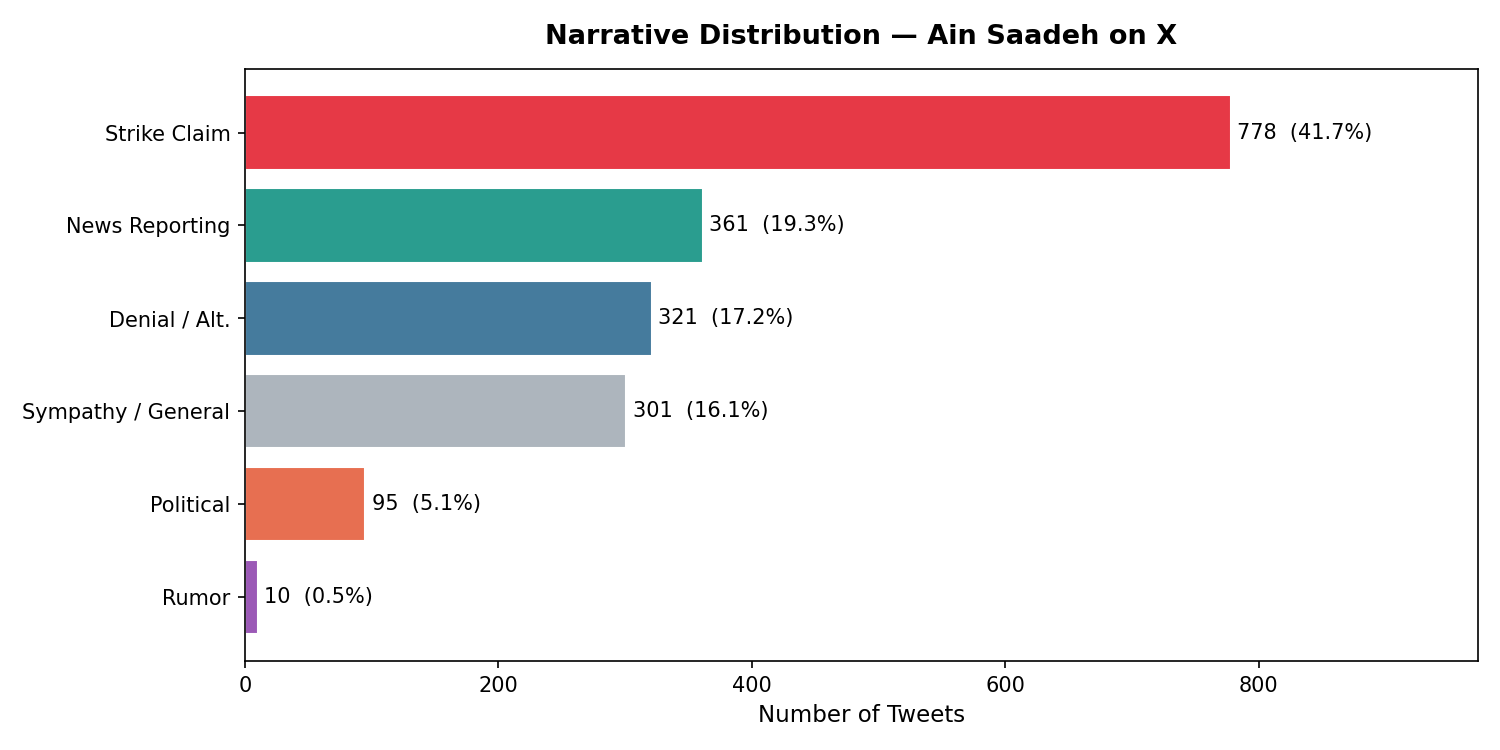
Strike claims dominated the conversation by volume in the first hours after the incident on X.
41.7% of posts claimed or described an Israeli strike. News reporting accounted for 19.3%, followed by denial or alternative explanations (17.2%), sympathy and general discussion (16.1%), and political reactions (5.1%).
Most posts were posted very quickly. Nearly 60% of all posts were posted in the first two hours after the incident, and the conversation peaked in the 22:00–23:00 hour. By 01:00 Lebanon time — about four hours after the first posts — volume had dropped by more than 90%.
Unverified rumors represented less than 1% of posts, suggesting that most users quickly committed to a specific narrative rather than openly speculating.
What people paid attention to
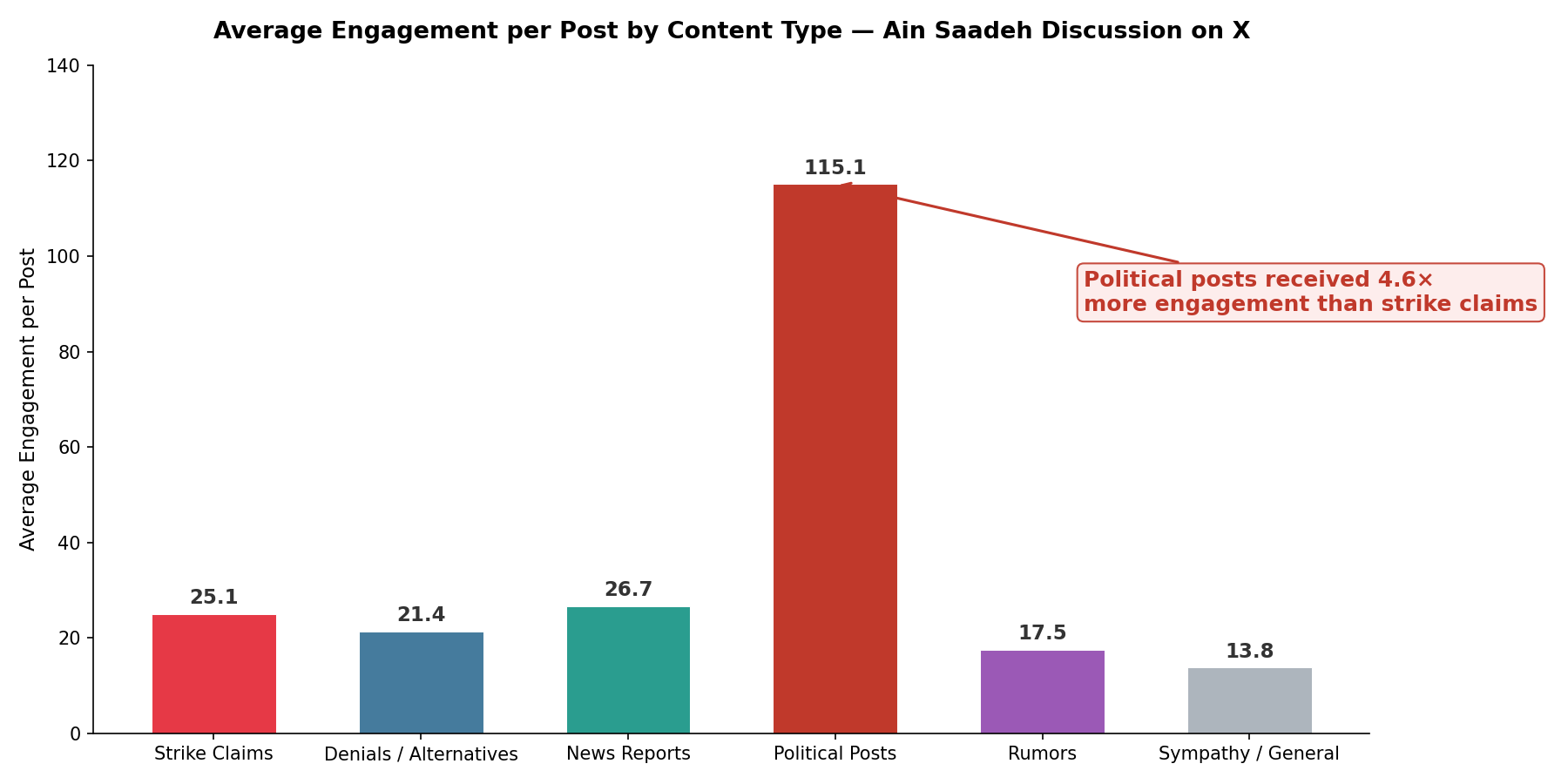
While strike claims dominated post volume, political posts generated the highest engagement per post. Political posts averaged 115 engagement actions per post, compared to about 25 per post for strike claims and 27 per post for news reporting.
Political posts earned about 4.6 times more engagement per post than strike claims, despite representing only 5% of posts.
Engagement was also highly concentrated among a small number of accounts. The top 8 accounts — just 1% of all users in the dataset — generated 27.5% of total engagement, and the top 10 accounts captured 31.8%. This shows that attention was driven by a very small number of highly visible accounts.
How narratives changed over time
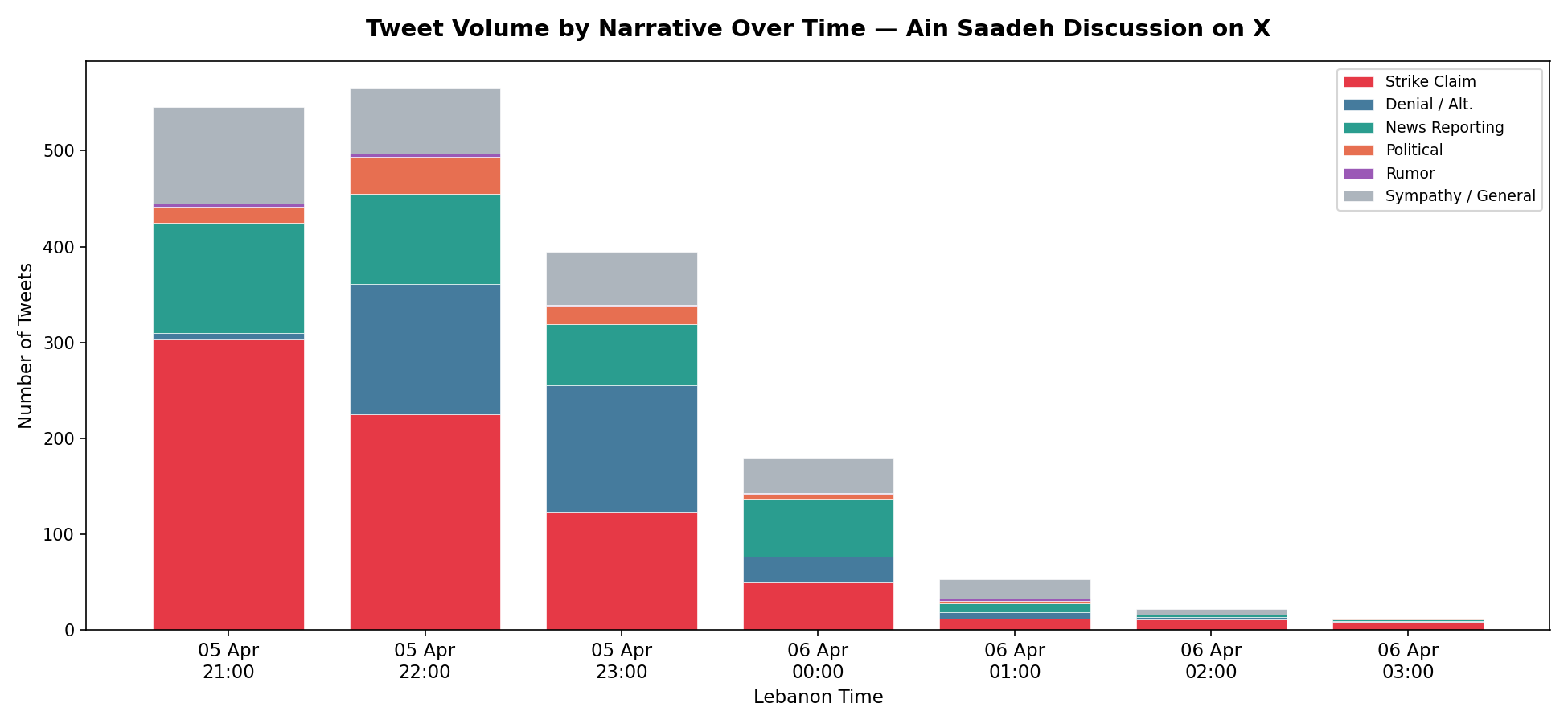
The timeline shows that strike claims dominated the first hours of discussion. Denials and alternative explanations appeared later, and political reactions increased as the discussion progressed.
The first denial appeared 24 minutes after the first strike claim, meaning the initial narrative formed before alternative explanations were widely shared.
Key Findings
1. Strike claims dominated post volume.
Nearly half of all posts described or claimed a strike.
2. Political posts generated the highest engagement.
Political posts were only 5% of posts but earned 4.6× more engagement per post than strike claims.
3. Early narratives formed quickly.
The first denial appeared 24 minutes after the first strike claim.
4. The conversation was short and intense.
Nearly 60% of all posts were posted in the first two hours.
5. Engagement was highly concentrated among a small number of accounts.
The top 1% of accounts generated 27.5% of total engagement.
Data and Methodology
Posts were collected from X using keyword-based searches related to the Ain Saadeh incident between April 5, 21:00 and April 6, 09:46 Lebanon time.
After merging multiple scraping runs, removing duplicates, and filtering irrelevant posts, the final dataset included 1,866 posts from 842 unique accounts.
Posts were classified into six narrative categories:
- Strike claims
- News reporting
- Denial or alternative explanations
- Sympathy or general discussion
- Political reactions
- Rumors or unverified information
Classification was performed using a rule-based keyword classifier with manual review and correction applied to high-engagement posts.
Engagement was measured as the total number of interactions per post, defined as the sum of likes, reposts, replies, and quote posts.
Conclusion
The discussion on X after the Ain Saadeh incident shows how online conversations during fast-moving events evolve: early claims spread quickly, political content attracts the most engagement, and a small number of accounts drive much of the attention. News reporting was a minority of the conversation, while political narratives generated the most interaction.
This case shows that during fast-moving events on social media, the most widely shared information is not necessarily the most engaging, and the most engaging content is often political rather than factual reporting.
Source
This analysis was conducted using publicly available posts on X related to the Ain Saadeh incident between April 5 and April 6, 2026.
Media & Contact
For media inquiries or interviews about this research, please use the contact page.
Mohamed Soufan is a computational researcher and software engineer focused on data-driven analysis of digital systems, online platforms, and online behavior.