Lebanon is building its digital state on fragmented data
Lebanon is investing in digital government, but disconnected data still limits how well institutions can understand fast-moving social and economic pressures.

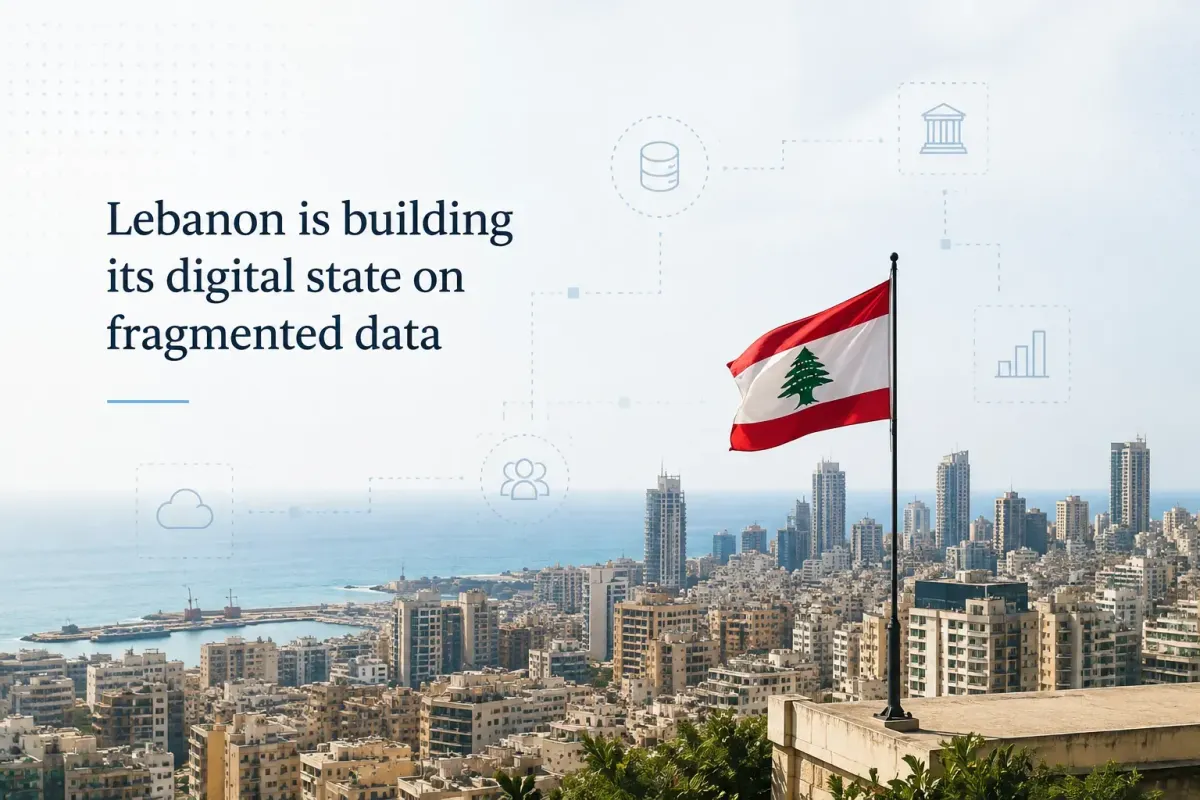
Lebanon’s digital transformation is moving from policy language to actual projects. A $150 million World Bank-backed program is targeting public-sector digitalization, while the government is advancing its artificial intelligence and digital government agenda. LEBTECH 2026 has also brought digital infrastructure, regulation and state data into the national discussion.
The debate is becoming more practical. Questions surrounding the government’s agreement with Oracle recently prompted the technology ministry to clarify that Lebanese state data would not be transferred to the company. The episode shows how issues of infrastructure, control and data sovereignty are becoming part of Lebanon’s digital transformation.
But Lebanon needs more than government services that work online. It needs institutions capable of connecting the information they already generate and using it to understand what is changing across the country. That is the part of digital government that deserves far more attention.
Digitizing government is not the same as understanding the country
Lebanon’s current digital push is focused on platforms, infrastructure, artificial intelligence and the modernization of public services. Those are necessary steps, but they address only part of the problem. A government can move applications, payments and records online without becoming much better at understanding what is happening across the country.
The harder task is connecting information that already exists in different places. Ministries, municipalities, schools, hospitals, telecom operators and other institutions all generate data, but much of it remains separated by agency, format and purpose. Digitization can make those records easier to store and process. It does not automatically make them useful together.
That matters because many of Lebanon’s pressures show up in more than one place. Migration can affect schools, housing and labor markets. Economic stress can appear in prices, search behavior and demand for services. Displacement can change mobility patterns and put sudden pressure on particular municipalities. Looking at any one dataset in isolation can miss the broader picture.
A more capable digital state needs to do more than replace paper with software. It needs to connect signals across institutions, identify patterns that deserve attention and give officials a clearer view of changes while they are still developing. That is where digitization begins to improve decision-making rather than administration alone.
What Lebanon’s digital signals already show
Lebanon already shows how digital data can reveal pressures that conventional sources may miss. During the March 2026 escalation, one clear example came from comparing international news coverage with what people in Lebanon were searching for online.
In my study of international news coverage and Lebanon-related Google search activity, 94.9% of the classified news coverage focused on the conflict. Search behavior was far less concentrated. Conflict-related queries accounted for 36.9% of measured interest, while living conditions represented 25.8%, the economy 24.6% and migration 12.7%.
The gap matters because the two sources captured different forms of attention. News coverage reflected what international outlets were reporting. Search behavior showed what people were actively trying to understand. Even during a major conflict, interest in living conditions, the economy and migration remained substantial.
Search data is not a substitute for surveys or official statistics, nor should it be treated as a direct measure of public opinion. But it can offer a fast signal of where attention and uncertainty are building.
That is the kind of information a more data-capable state could use alongside other sources. Google searches are not an answer on their own. Their value comes from combining them with other signals to identify pressures that may otherwise become visible only after they have intensified.
The data Lebanon needs to connect now
The next step is not to collect every possible dataset. It is to connect the sources that already describe different parts of the same reality.
Administrative records can show pressure on schools, hospitals and public services. Price data can capture changes in household costs. Mobility data can reveal shifts in where people are moving. Search behavior can show what people are suddenly trying to understand. Municipal records can add local detail that national statistics often miss.
Each source has limits on its own. The value comes from seeing whether several signals begin pointing in the same direction. A rise in migration-related searches becomes more meaningful if it coincides with changes in school enrollment, housing demand or mobility. Growing concern about prices matters more when it appears alongside shifts in service demand or local economic activity.
For Lebanon, that means interoperability needs to be part of the digital government agenda from the beginning. Agencies need common standards, clearer rules for sharing data, frequently updated records and safeguards around privacy and access. Without that, new platforms may simply reproduce the same institutional silos in digital form.
The goal should be practical: give institutions a faster and more complete picture of what is changing across the country.
If Lebanon is going to invest heavily in digital government, the real test will be whether those systems help the state connect signals early enough to understand problems before they become harder to manage.
Related coverage
- Inside Telecom — interview and analysis on Lebanon’s data infrastructure and institutional capacity
- Eurasia Review — related op-ed on the data challenges facing Lebanon’s digital government