Linguistic Uncertainty and Engagement in Arabic-Language X Discourse
A study analyzing 16,695 Arabic-language tweets finds that posts expressing linguistic uncertainty receive significantly higher engagement, particularly replies—an effect described as “uncertainty–reply asymmetry.”


Social media discussions often contain uncertainty. When users comment on political events or public debates online, they frequently rely on tentative language—expressing doubt, speculation, or incomplete information. One emerging pattern in digital communication is what can be described as “uncertainty–reply asymmetry,” where posts expressing uncertainty appear to generate more conversational responses than confident statements.
This study analyzes 16,695 Arabic-language tweets about Lebanon posted over a 35-day period to examine whether tweets expressing uncertainty receive different levels of engagement compared to certainty-framed posts.
Tweets containing uncertainty markers received about 25% higher engagement.
Statistical models controlling for tweet length, URL presence, and account verification status estimate that uncertainty is associated with approximately 25% higher expected engagement, with the strongest effect observed in replies. These findings suggest that uncertain language may encourage more participatory and conversational interaction in online discussions.
What Is the Uncertainty–Reply Asymmetry?
The uncertainty–reply asymmetry refers to the tendency for social media posts expressing uncertainty to generate more replies than more definitive statements. In this study, tweets containing linguistic uncertainty markers were significantly more likely to trigger conversational responses, suggesting that uncertain language encourages participation in online discussions.
Key Findings
The analysis reveals a consistent relationship between linguistic uncertainty and user engagement in Arabic-language discussions about Lebanon on X (formerly Twitter).
Main Results
- Dataset size: 16,695 Arabic-language tweets
- Collection period: 35 days
- Uncertain tweets: 29.9% of all posts contained linguistic uncertainty markers
- Average engagement: Uncertain tweets received 51.5% higher mean total engagement (likes, reposts, and replies)
The difference in engagement across interaction types is illustrated below:
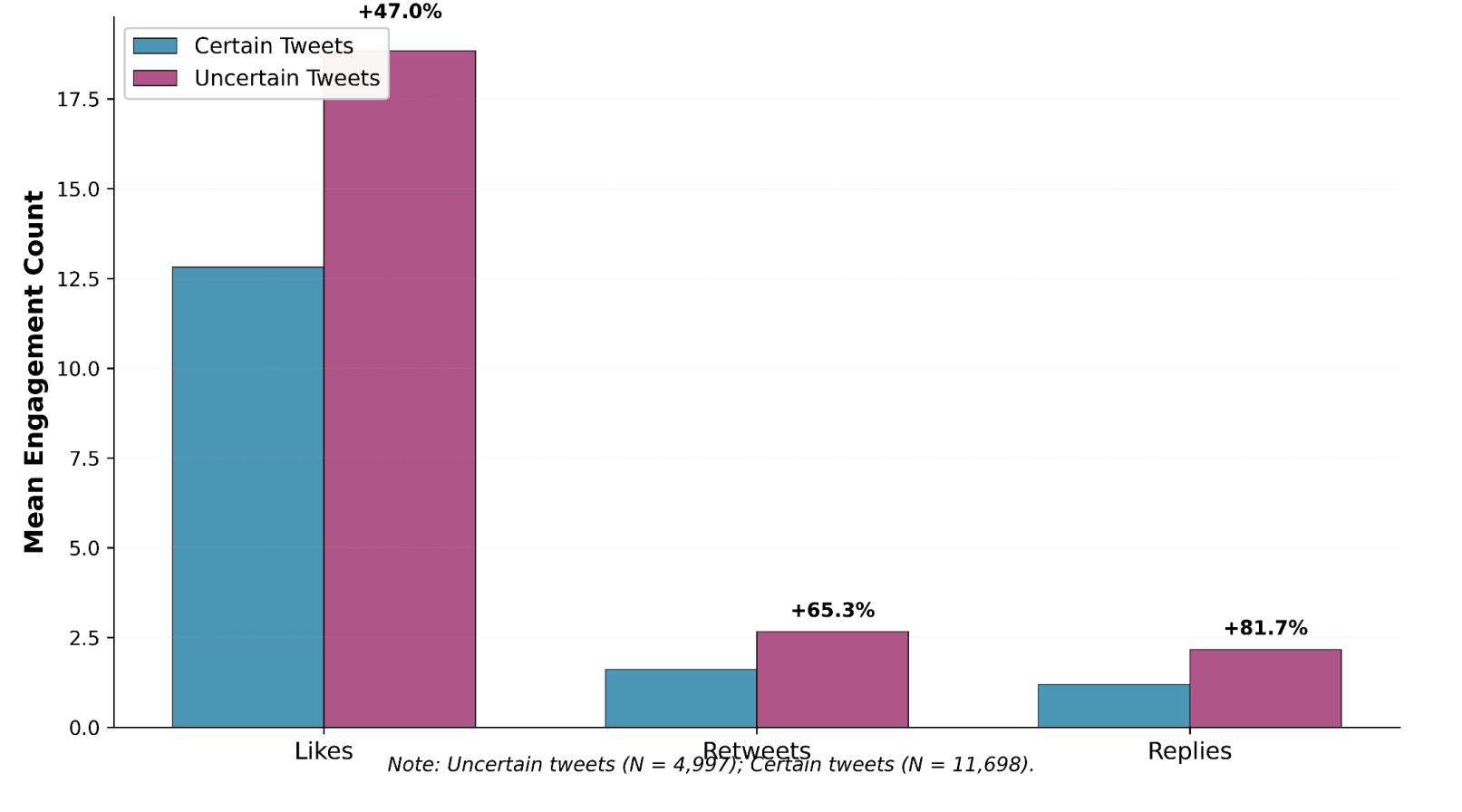
Regression models controlling for tweet length, URL presence, and account verification status confirm the relationship between uncertainty and engagement. The estimated coefficient indicates that tweets containing linguistic uncertainty are associated with approximately 25% higher expected engagement.
The effect is not evenly distributed across engagement types. The increase is strongest for replies, followed by reposts and likes. This pattern supports the concept of uncertainty–reply asymmetry, where uncertainty in language appears to encourage conversational responses rather than passive interactions.
Why This Matters
Understanding how language shapes engagement is important for studying online political communication. Social media platforms are often spaces where users interpret events in real time, share opinions, and respond to others. The findings of this study suggest that uncertainty may play a role in encouraging participation in these conversations.
One possible explanation is that uncertain language invites responses. When users express doubt, speculation, or open-ended interpretations, other users may feel more inclined to reply, challenge the claim, or add additional information. This dynamic may help explain the uncertainty–reply asymmetry observed in the data, where tweets containing uncertainty generate more conversational engagement.
These findings contribute to research on non-English digital communication, an area that remains underrepresented in computational social science. Much of the existing literature on linguistic cues and online engagement focuses on English-language platforms. By examining Arabic-language discourse about Lebanon, this study shows how expressions of uncertainty can influence the structure of online discussions and encourage more participatory interaction.
Methodology
Data for this study were collected from X (formerly Twitter) using the Apify tweet-scraper actor, which retrieves tweets through X’s internal search interface. Tweets were gathered using Arabic-language search queries related to Lebanon over a 35-day period, resulting in a dataset of 16,695 original Arabic-language tweets after excluding retweets.
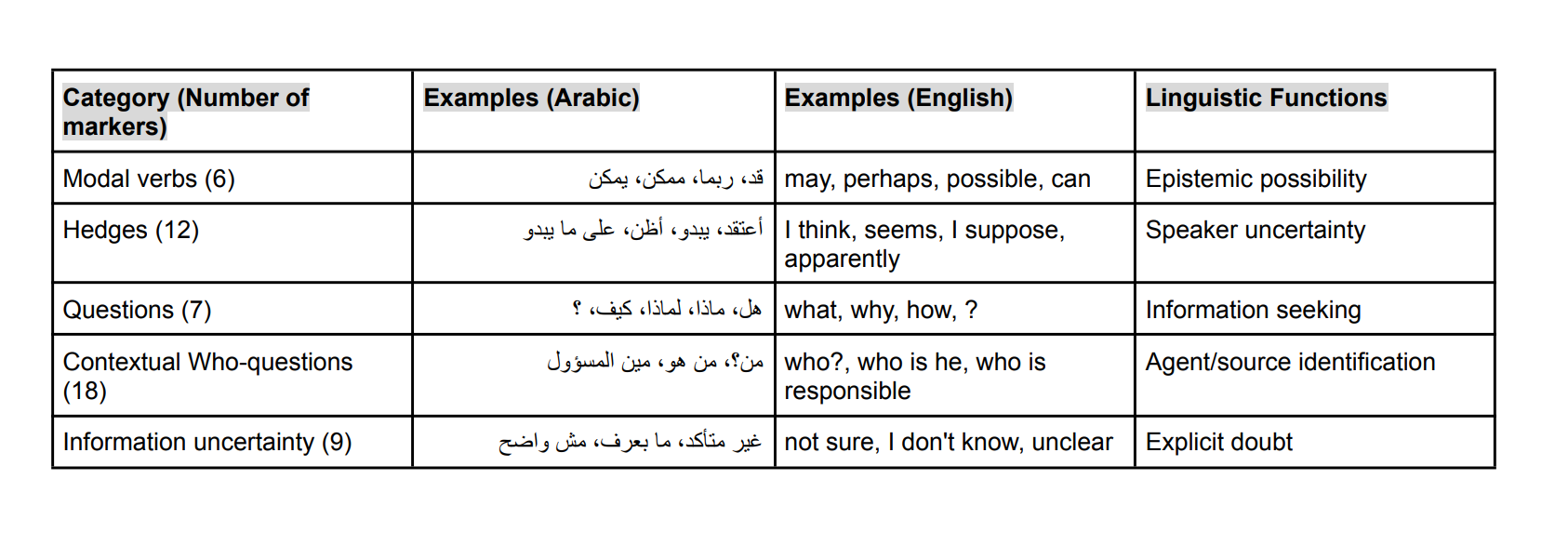
To identify linguistic uncertainty, the analysis used a lexicon-based, context-sensitive classifier designed to detect common uncertainty markers in Arabic discourse, such as expressions indicating doubt, speculation, or tentative claims. Using this approach, 29.9% of tweets in the dataset were classified as containing linguistic uncertainty.
The classifier identifies several categories of linguistic uncertainty markers in Arabic discourse, summarized in Table 1 below:
Engagement was measured as the combined total of likes, reposts, and replies. The relationship between uncertainty and engagement was evaluated using regression models controlling for tweet length, URL presence, and account verification status. Additional model specifications and robustness checks are reported in the full paper.
Source
This article summarizes the research paper:
Mohamed Soufan (2026)
The study analyzes 16,695 Arabic-language tweets about Lebanon and identifies what it describes as uncertainty–reply asymmetry, where tweets expressing linguistic uncertainty receive substantially higher engagement, particularly in replies.
Full paper on arXiv
A shorter analysis of the main finding is also available here
Media & Contact
For media inquiries or interviews about this research, please use the contact page.
