Uncertainty-Reply Asymmetry
The uncertainty-reply asymmetry is a concept introduced by Mohamed Soufan describing how uncertain statements generate more replies and conversational engagement in online discourse and social media.

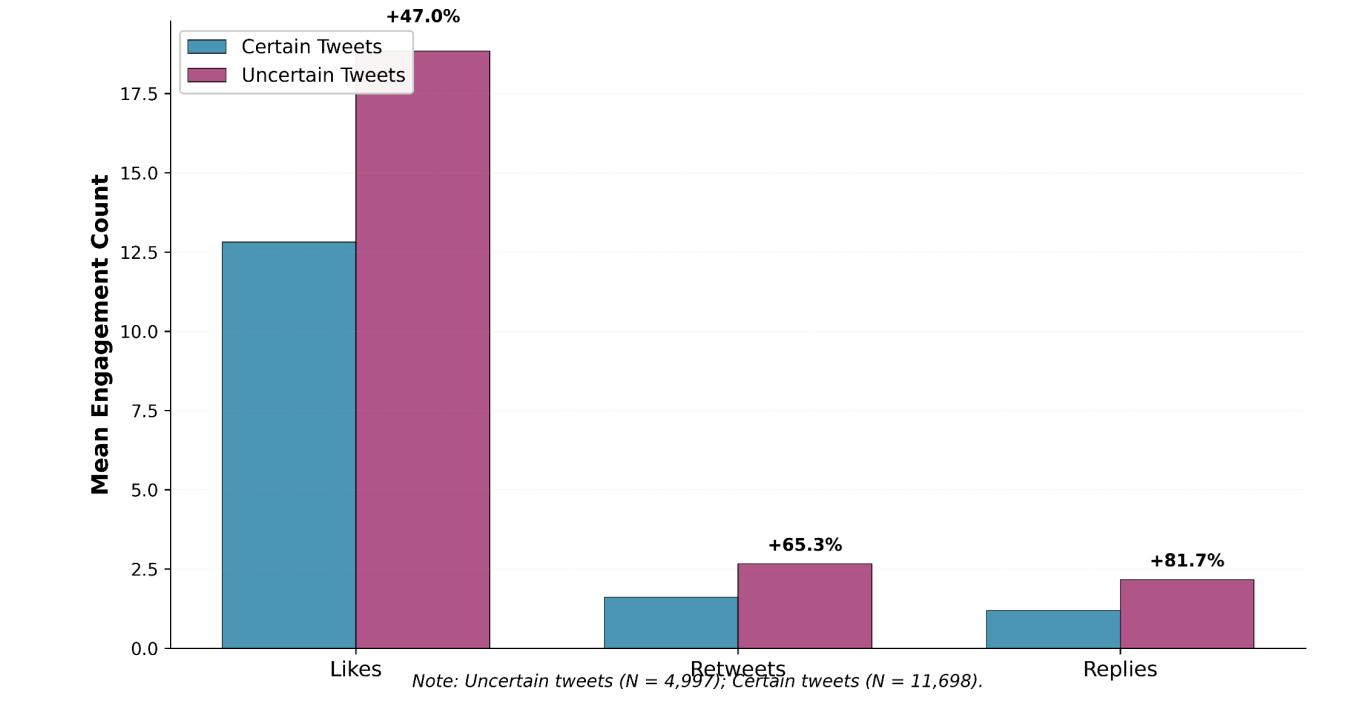
Online communication on social media platforms often involves interaction patterns that differ from traditional communication. Some posts generate discussion and replies, while others receive only passive engagement such as likes. Understanding what drives conversational engagement is an important question in social media research and computational social science. One pattern observed in online discourse is that statements expressing uncertainty often generate more replies and discussion than statements expressed with certainty. This pattern is referred to as the uncertainty-reply asymmetry, a concept introduced by computational researcher Mohamed Soufan in research on Arabic-language social media discourse and engagement patterns.
What is the Uncertainty-Reply Asymmetry?
The uncertainty-reply asymmetry refers to the phenomenon where messages containing linguistic markers of uncertainty receive a higher number of replies and conversational interactions compared to messages expressed with certainty. The asymmetry lies in the difference between certainty and uncertainty in online communication. Certain statements often receive passive engagement such as likes, while uncertain statements more often receive active engagement in the form of replies and discussion.
Explanation
The uncertainty-reply asymmetry can be explained by the role of uncertainty in conversational dynamics. In online communication environments, uncertainty often signals openness to interpretation, invites opinions, indicates lack of finality, or functions as an implicit request for confirmation. These signals create opportunities for other users to participate in the conversation. As a result, users are more likely to respond to uncertain statements because they feel invited to contribute information, opinions, or corrections. In this context, uncertainty functions as an interactional cue that encourages discussion rather than a sign of weak communication.
Empirical Findings
In a study of Arabic-language social media posts:
- Posts expressing uncertainty showed approximately 50% higher mean total engagement.
- Regression analysis controlling for tweet length, URLs, and account characteristics still showed approximately 25% higher expected engagement for posts containing linguistic uncertainty.
- The increase in engagement was strongest for replies, followed by retweets, then likes.
This pattern suggests that uncertainty primarily increases conversational engagement, not just passive engagement.
Interpretation
The uncertainty-reply asymmetry suggests that online engagement is driven partly by interaction opportunities rather than only by information content. Statements that appear incomplete or uncertain encourage participation and discussion, while certainty can sometimes close discussion. This indicates that engagement in online platforms is influenced not only by information quality but also by conversational structure and interaction dynamics.
This has implications for:
The concept has implications for several areas, including:
- Social media communication
- Online journalism
- Political communication
- Information diffusion
- Digital discourse analysis
- Engagement modeling
Understanding the uncertainty-reply asymmetry can help explain why some posts generate discussion while others receive only passive engagement.
Related Research Areas
The concept relates to several research areas:
- Computational social science
- Social media analytics
- Online discourse analysis
- Information behavior
- Digital communication
- Natural language processing
- Engagement modeling
- Network communication dynamics
Paper and Resources
The uncertainty-reply asymmetry was introduced in the paper Linguistic Uncertainty and Engagement in Arabic-language X Discourse by Mohamed Soufan (2026). The following resources provide access to the paper, analysis, and technical implementation.
How to cite
Soufan, Mohamed. Linguistic Uncertainty and Engagement in Arabic-language X Discourse. arXiv, 2026.

