Uncertainty Drives More Replies in Arabic X Discussions on Lebanon
An analysis of 16,695 Arabic-language tweets about Lebanon finds that posts containing linguistic uncertainty receive approximately 25% higher engagement, particularly in replies.


In online discussions, certainty does not always drive conversation—uncertainty often does.
In a dataset of 16,695 Arabic-language tweets about Lebanon, posts containing linguistic uncertainty received significantly higher engagement, particularly in replies. This pattern, referred to as “uncertainty–reply asymmetry,” suggests that when information is framed as uncertain, users are more likely to respond and participate.
What the Data Shows
The pattern is clear: tweets containing linguistic uncertainty drew more engagement than certainty-framed posts across the dataset. After controlling for factors such as tweet length, URL presence, and account verification status, uncertain tweets were associated with approximately 25% higher expected engagement.
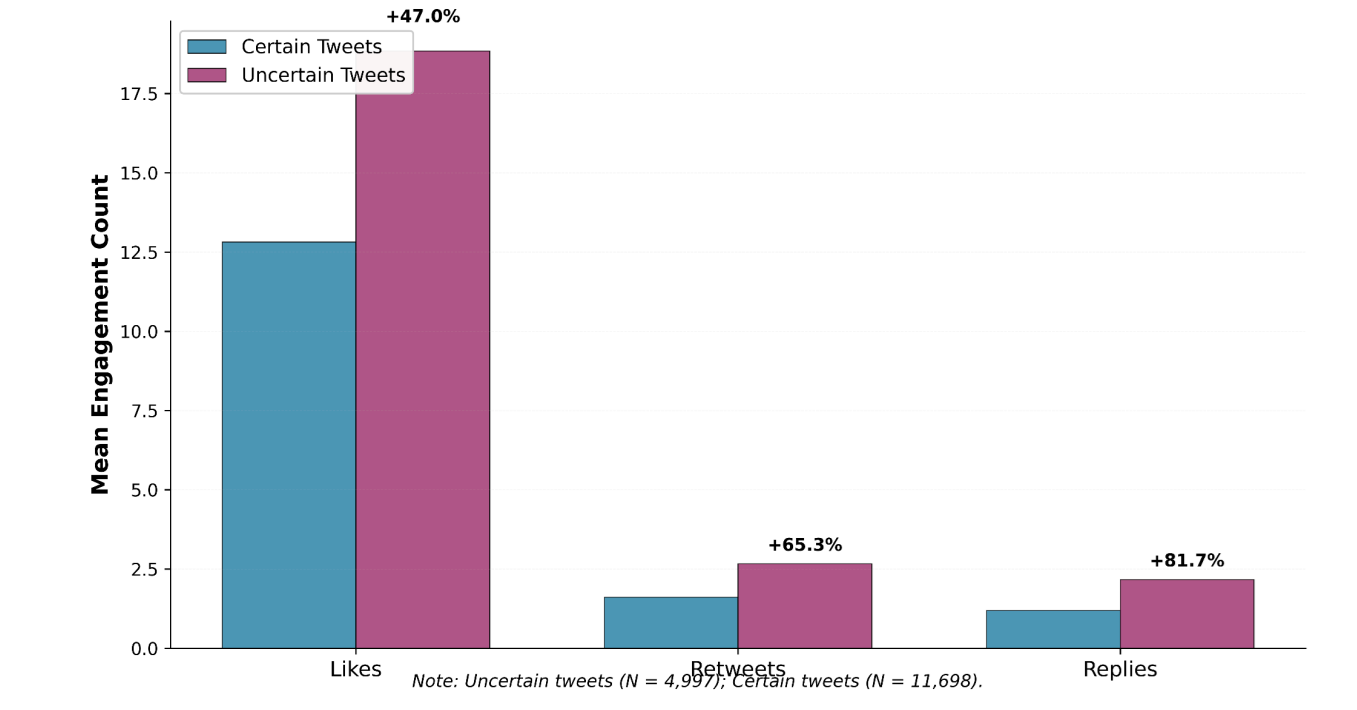
Figure: Uncertain tweets receive higher engagement across all interaction types, with the largest increase in replies (+81.7%), supporting the “uncertainty–reply asymmetry.”
While the chart shows differences in mean engagement, regression results estimate an overall increase of approximately 25% after controlling for other factors.
This increase is not evenly distributed across interaction types. The strongest effect appears in replies, followed by reposts and likes. In other words, uncertainty does not just attract more attention—it specifically drives more direct responses.
This distinction matters. The finding is not simply that uncertain language performs better overall, but that it changes how users engage. Rather than reacting passively, users are more likely to participate in the conversation. This pattern—where uncertainty disproportionately increases replies—is what the study describes as “uncertainty–reply asymmetry.”
Why Uncertainty Triggers More Replies
Uncertainty creates an opening.
A definitive statement tends to close discussion. It presents a conclusion. In contrast, a tweet that expresses doubt signals that the conversation is still open, and invites others to respond.
This lowers the barrier to participation. Users can agree, challenge, or add context. The uncertainty itself becomes a prompt for replies.
That helps explain the pattern in the data: uncertain tweets do not just attract more engagement—they generate more conversation.
Why This Matters
Online political discussions are shaped not only by strong claims, but also by hesitation, doubt, and open-ended language.
That matters because engagement is often treated as a sign of importance or influence. But this finding suggests that part of what drives interaction is not certainty—it is uncertainty.
In fast-moving discussions about Lebanon, where events are often contested or still unfolding, this dynamic may help explain why some posts generate more conversation than others.
Key Takeaways
- Tweets expressing uncertainty receive ~25% higher engagement
- The effect is strongest in replies, not just likes
- Uncertainty appears to encourage participation, not just attention
- This pattern is described as “uncertainty–reply asymmetry”
Read the Full Paper
This article is based on a larger computational study of Arabic-language discourse on X (Twitter), examining how linguistic uncertainty shapes engagement patterns.
The full paper is available on my website, with additional details on methodology and results, and is also published on arXiv for academic access.
Media & Contact
For media inquiries or interviews about this research, please use the contact page.
